Pope Francis, the leader of Catholic Christians, died today (on Easter Monday) aged 88.
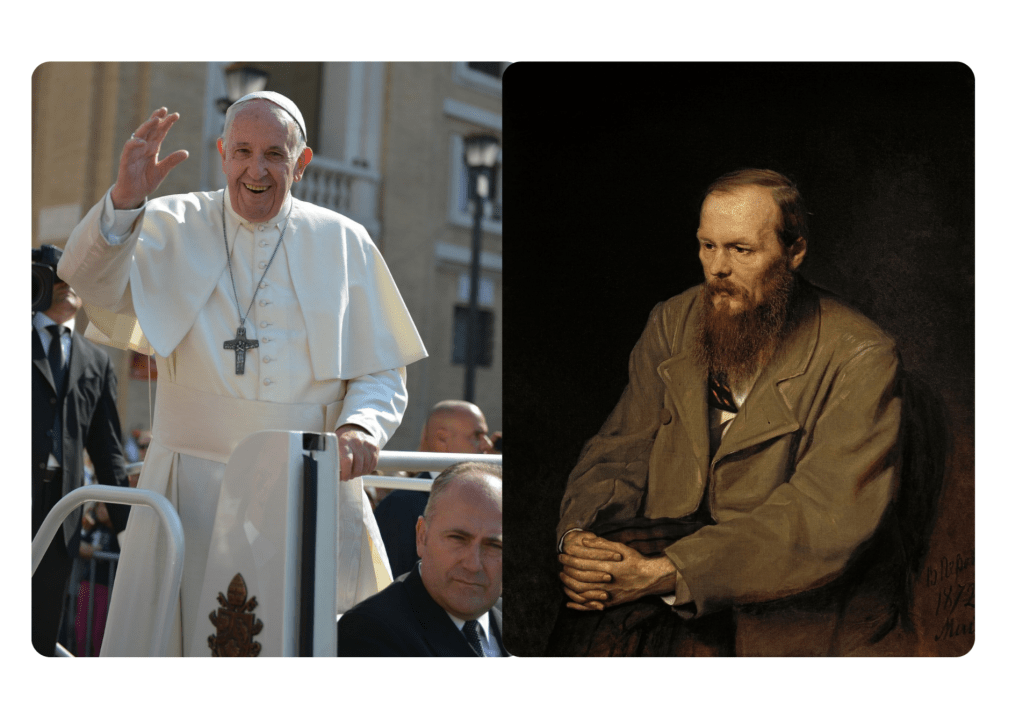
Today we talk about Why Pope Francis Holds Dostoevsky in Such High Regard
In a world often defined by secularism and individualism, the Catholic Church has found in Fyodor Dostoevsky a profound voice that speaks to the deepest parts of the human condition. And Pope Francis, the head of the Catholic Church, is one of the most prominent figures to publicly admire and reflect on the work of this 19th-century Russian novelist. While there is no personal connection between them—since Dostoevsky died in 1881—the spiritual and philosophical ties between them are striking.
Pope Francis has long referenced Dostoevsky, praising the writer’s exploration of the human soul, sin, grace, and mercy. His admiration for Dostoevsky is not just literary; it is deeply theological.
In a 2022 interview, Pope Francis reflected on Dostoevsky’s continuing relevance, acknowledging that the writer’s work continues to inspire Christians to understand the complexities of their faith and their need for divine mercy.
The Role of Mercy
In Crime and Punishment, Raskolnikov, the novel’s protagonist, is not saved by punishment, but by the compassionate love of Sonya, a character who embodies Christ-like mercy. Similarly, Pope Francis frequently emphasizes that it is not condemnation, but the love and mercy of God, that leads to redemption. In fact, in his 2015 address to a group of priests, the Pope quoted Dostoevsky’s character Elder Zosima from The Brothers Karamazov: “Do not fear. Never fear, and do not be sad, so long as your remorse does not dry up, God forgives everything.” The Pope used this quote to highlight the transformative power of mercy and forgiveness, which is central to both Dostoevsky’s writings and Francis’s ministry.
Faith, Freedom, and Doubt
Another significant theme in both Pope Francis’s thought and Dostoevsky’s works is the struggle between faith and doubt. Dostoevsky’s characters often grapple with profound questions about God, justice, and human suffering. In The Brothers Karamazov, Ivan Karamazov famously questions the existence of a benevolent God in a world filled with suffering. This deep wrestling with faith is something Pope Francis can relate to, as he has often spoken about the difficulties of belief in a modern world marked by doubt and confusion.
A Shared Vision of Christ’s Love
Finally, both Dostoevsky and Pope Francis share a radical commitment to Jesus Christ at the center of everything. Dostoevsky once wrote, “If someone proved to me that Christ is outside the truth, and that the truth really did exclude Christ, I should prefer to stay with Christ rather than with the truth.” Pope Francis echoes this radical loyalty to Christ, urging Christians to follow Jesus with humility and love, rather than rigid legalism.
The relationship between Dostoevsky and Pope Francis is a profound one, rooted in a shared understanding of human frailty, faith, and the need for mercy. Dostoevsky’s exploration of sin and redemption, his questioning of institutional power, and his insistence on Christ’s central role in life resonate deeply with the Pope’s vision of a Church that offers hope to the broken and freedom to those who seek it. In Dostoevsky’s works, Pope Francis finds not just a literary giant, but a companion on the journey of faith.


 The Hemlock Journal
Leave a comment