The Hemlock Journal is currently accepting submissions for Poetry Writing Contest. Click here to participate.
It is said that the tresses of our hair are infused with fragments of our memory. I realize this as my grandmother runs her fingers through my hair. She weaves my braid as she weaves her tales. The tip of her finger renders an electrifying touch which stirs up my memories like a magic potion. The strands of my memory get reconstructed as I immerse myself in her recollection of the bygone era. She takes me back to the beautiful natural scape of the juicy ripe mangoes in our courtyard in Bangladesh. Her eyes glisten with dewy eyed wonder as she talks about the delectable flavours she savoured as a young girl. I peek through the blinds, in the windows of her mind and through my gestalt perception I smell the wet soil of a monsoon ridden Bangladesh. The pluviophile in me rejoices as she hardly experiences this within the concrete, urbanized space of Calcutta, India.
Summers in Calcutta hardly smell of ‘mati’(Soil in Bengali). It smells mostly of wet concrete and sounds like rainwater splashing against car windows. My gaze is slowly drawn to the ants filing up near the can of jaggery (gur) prepared by my grandmother. I wonder how these ants move.I’ve mostly seen them move in defined circles or straight lines, almost in a military fashion. Did some of these ants cross the border over from Bangladesh just like my grandmother? Are they also branded as a “refugee’’, as an “outsider” in their ant colonies? Is their identity also conflicted? I notice the straight lines of the ants bifurcate into two: some moving towards the artificially processed honey bottles while some choose to remain with the natural, home made jaggery. My Professor would have compared this to the post modern individual suspended between tradition and modernity.
However, I view the conflict as something much deeper. It is almost as deep as the pious waters of the Ganges flowing into ‘Padma’ in Bangladesh. The Partition of 1947 and the subsequent War of Independence in East Pakistan in 1971 had turned these waters red, transforming it into the mythical river Styx (the river of Death in Greek mythology). Bangladesh was born out of conflict as the seed of mukti (freedom) burgeoned into a tree. But as far as the victims of the crushing realities of war were concerned, the conflict had just begun.
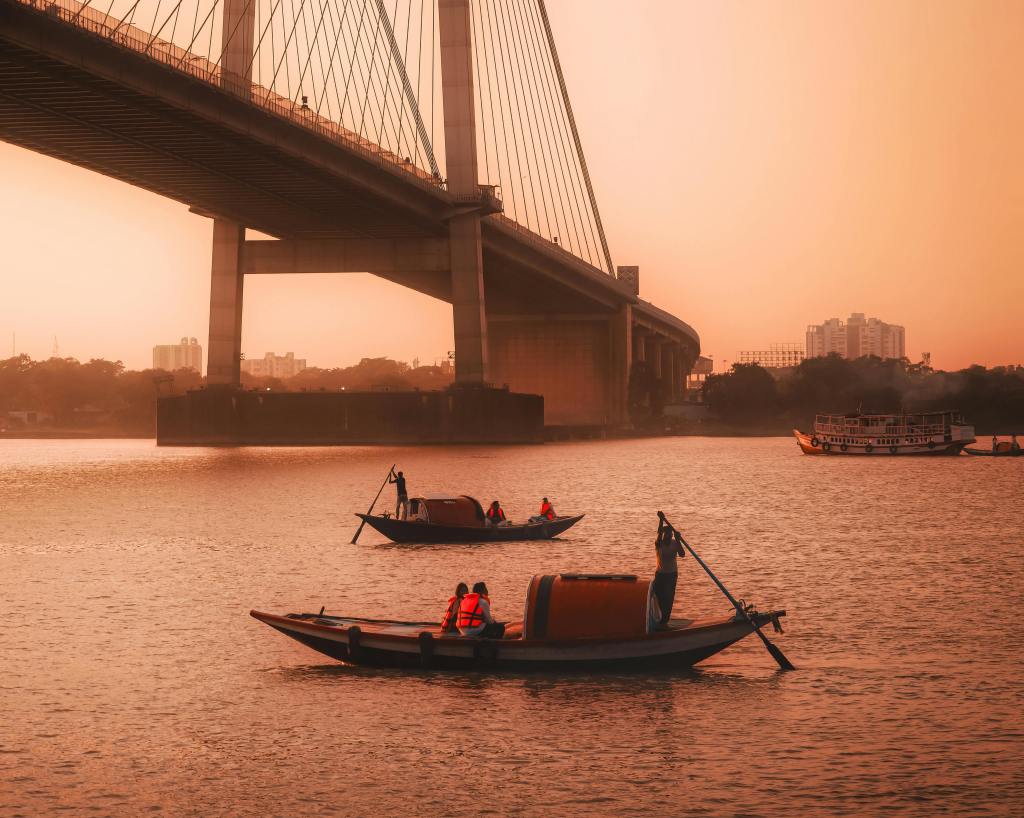
The counterpart to the Styx river in Hindu mythology is the Vaitarna river. It seems as though my grandmother crossed the Vaitarna river on a boat when she came to India. This boat was and still is her vessel of grief, a scathing reminder of the murdered kin she left behind in Bangladesh.
Sometimes, I imagine myself as a voyager on that boat, wading through waters filled with memories I inherited from my grandmother.Have I inherited her conflicted state as well? I have never had to worry about straight lines, borders or circles. My existence has always been fluid, it ebbs and flows like the tides in river Ganga.But then again more often than not I have felt like a lone red ant in a colony of black ants. I have felt my Bangladeshi roots being belittled by my paternal relatives who were never ousted from their homeland.
My conflict manifests itself as a schism, an insidious crisis spreading across the varicose veins of my body. India is the flowerbed for those who were deracinated from their homeland like a weed in a wasteland. I love the smell of the diverse flowers of this India, which encapsulates ‘home’ for me.
But just like the Indians in an anglicized British India, I feel distant from my own home as I trace my lineage and genetic memory.I trace the roots of the sacred Banyan tree common to both these countries and I realize the same earth binds these roots. The only way we can transcend conflict is through a celebration of our humanity and humanness. We are most alike in our ‘human identity’, which solidifies our position against the larger meta narratives of factionalism, discrimination and prejudices.
About the Author

Somedutta is a second year student at Miranda House, Delhi University. She is currently pursuing her graduation as a BA(Hons.) English student at the aforementioned institution. Besides being academically inclined, she is a passionate debater, elocutionist, an avid reader and a published writer. Somedutta holds several positions of responsibility in college societies and unions, including the position of the General Secretary in the Literary society.She has several credentials in Debating tournaments(Conventional debates, Parliamentary debates, Adjudicator in College level debating) elocution (slam poetry), theatre and policy based competitions (IR and Literature). Moreover, she exhibits a drive for academic writing and research work and has published herself in journals and anthologies such as the Kenyon Review, Ohio Arts Council,USA. For her, an active engagement in co-curricular activities is way to broaden her horizon and forge stronger connections with those around her.


 The Hemlock Journal
Leave a comment