How does Ghalib Ki Haveli attract poets and readers from a wide range of linguistic cultures across India and Beyond?
-Poorvi Kapoor
Upon entering the lanes of Chandni Chowk, I first got lost in the maze of small Gallis. The magical scent of kachoris, paranthas, and crowd reminded me that I was on Delhi’s busiest street. Having visited Old Delhi, a few times, I thought how hard it would be to find a Haveli. But later I realized that the stories that I heard from my grandparents about Old Delhi’s culture felt betrayed. If you stand at the entry, you can see two different places- A utopian land resurrected as a government attempt to preserve glory and land, with real people still suffering.
Delhi meant the Fort, the Chandni Chowk, the daily bazaar near Jama Mosque, the weekly trip to the Jamuna Bridge, and the annual Fair of the Flower-sellers. These five things are no more. Where is Delhi now? Yes, there used to be a city of this name in the land of Ind[ia], sobbed Ghalib’s heart.
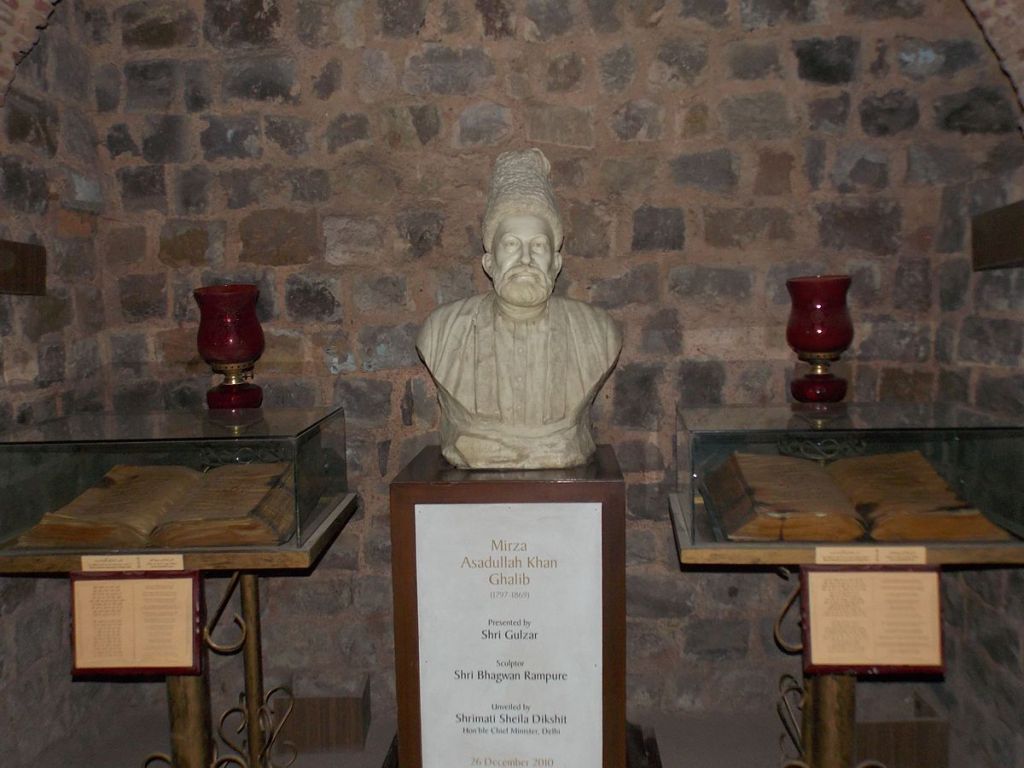
It was a small arch that welcomed me into the dungeon of the history of Ghalib’s poetry. The long red curtains, embroidered carvings, and true arch looked like a flaw to the falsehood promised under the name of resurrection. I sighed and felt like I had been transported to a chamber of cultural heritage and not a land where some of the biggest poetic pieces were born.
With no proper guiding signs or panels, I felt lost; but soon into the world of nazms and shers, especially the ones that portrayed Ghalib’s love for Delhi. This haveli served as patronage to Mirza Ghalib’s art but ended up extracting the loss of Ghalib’s life revolt. Just like a failed attempt to keep a broken vase alive with cello tapes, Mirza Ghalib’s haveli is a testament to development’s failed attempt to save the destroyed Galli and Mohallas of Delhi.
Take Me, Leave My Delhi
Urdu poetry came to Delhi by the 18th century, as a part of the Mughal lineage blending core languages like Persian, Arabic, Turkish, and local Indian. This gave rise to many historians, scholars, and most importantly the evolution of art and culture. That’s how Delhi, a great center of disputes, started its transformation into a land of glory and tradition.
By 1810-1812, Delhi saw the rise of an acclaimed poet- Mirza Asadullah Baig Khan or Ghalib. After his years of elementary education in Agra, Ghalib shifted to Delhi and immersed himself in literary circles. He sought patronage from the Mughal court in an attempt to entertain people with his love for poetry. Despite facing financial difficulties and personal tragedies, he managed to secure a position as a court poet. But then came a tragic turn, the revolt of 1857, and the loss of the Mughal empire that started impacting his life and career.
Indeed, the land that was once known for its rich culture turned into a sanctuary of political turmoil. The city was now forced under the scrutiny of lamentation. As a result, Ghalib and Urdu Literature faced a backlash. Ghalib’s distinguished love for the cultures of Delhi was numbed into ruins, battles, and sorrow. Delhi’s metaphor faced British captivity and the revolt was incarcerated.
That said, Ghalib in an attempt to relieve his pain, maintained a diary by the name, Dastanbuy, describing the loot and killing in the hottest months of Delhi. His diary criticized the rebellious soldiers and their
disbelief in the British empire. At first, he was sympathetic to the British and disparaging to the rebels, but later he revolted against the power.
As a fellow Muslim, he started sympathizing with the rebellions, celebrated the liberations, and grieved for a depleting Delhi. He disapproved of the British Government’s decision to ban Muslims whom they distrusted from Delhi only to allow them to pay a fee later.
“They ruin you and tell you that you are settled.”
Our Love is Like the Wind
I attribute Urdu to a love and revolt language. It’s the perfect way to portray love to your beloved through ghazals or start a revolt with powerful nazm. Hence, it became the language of the Mughal Empire. On one end where India was still struggling to find its identity, the question of being in an unsolicited India came into existence. And Urdu was a major victim of this shift.
When the Mughals came to India, they used Urdu as a reformation language and hence, poets like Ghalib, traced their paths to the Mughalised Delhi. They set up their love for the language, city, and people and used it to write about a big revolt. Besides using Urdu, Hindi also found its roots through a common ancestorial. However, the Mughals focused more on Urdu literature as a way of promoting their lineage.
But since the revolt ended in another revolt, the Mughal dynasty was soon invaded by the Britishers. Rulers were killed, rebellions were sent to exile, and artists were deprived of expression. Ghalib’s poetry centered around the Urdu language was now covered in dark clouds of politics. The land which he loved the most, Delhi was now covered with blood baths. This affected Ghalib and his writings.
The British Government found a profound impact of Urdu on people and hence, crafted their policies and administrative decisions in a way that resulted in the decline of the Urdu Literature. When the East India Company initially began its control over India, Persian was used as the court language, and Urdu for administrative work. But they soon discovered that if they had to rule over people, it required collapsing their languages and using it against them to divide and rule.
With this motive, Lard Macaulay employed the English Education Act that promoted English as the medium of instruction in schools. This was done to sideline other languages, including Urdu to create a class of English-educated Indians who would run the administration. With time, Urdu was also replaced in the courts by English to build a strong English domination.
By now the Britishers knew that to build an empire they would have to create a controversy between Hindi and Urdu. Hence, they agreed to the demands of Hindu petitioners to replace Urdu with Hindi in the Courts. Urdu was now marginalized from the courts and the lands of India, emphasizing religious and cultural divisions between the country. Textbooks, curriculums, and literary patronage all suffered a huge pushback when Hindi was promoted. This led to a huge impact on the linguistic landscape of North India.
Another weapon used by the Britishers in this context was in 1857, which removed major Muslims and Urdu speakers from the lands of Delhi. The land that was once loved for Urdu, was now shattered by the Britishers. Poets and artists lost their distinguished art.
By promoting English and Hindi, the Britishers managed to decline Urdu. This consolidated their power in the North and created an impact that the Mughal rule is now over. But as every revolt had a positive outcome, India too gained back its independence. But cities like Delhi, Lucknow, and Hyderabad in India, which had been major centers of Urdu literature and culture, saw significant cataclysm. As a result, many Urdu writers moved back to Pakistan leaving a part of their lineage in India. The partition was a consequence of mistrust between the Indian natives that survived the Britisher’s rule for so long.
Urdu, the language of love that was once one of the most impactful languages lost its roots in the Indian soil. Artists were misplaced and Urdu got the new title of being called an outside language. This impact was heartbreaking for the people who had to misplace and forget their Old Delhi. But this was not the end of revolts, the Hindi and Urdu battle is still used by people to dominate power. The dispute continues in parts of India along with Hindu-Muslim biases.
However, the government has made several attempts to resurrect this forgotten language. Old libraries, literary circles, and educational institutions protect the lost Urdu Literature. Even after years of revolt in politics post-independence, the land of Ghalib’s lineage was resurrected into Mirza Ghalib Ki Haveli.
Failing to recover, Falling into Misery
You could easily get lost in the small gallis of Old Delhi, but “Ghalib Haveli” serves as a metamorphosed modern heritage site. It’s the holy land for the people who love art and culture from their heart and a touristy place for others. Needless to say, I was there as a former person. My love for poetry specifically Urdu Poetry grew when I started reading random shayaris on Instagram. They might not have been the perfect exposure to Urdu culture but enough to make me fall in love with it.
As time passed and I immersed myself in more literary circles, I got acquainted with poets like Ghalib, Faiz Ahmad Faiz, and Gulzar. A Ghalib book in hand and quoting his poetries randomly- this became my true identity in my Undergraduation. And my interest in looking at the culture developed more when I heard about Old Delhi. It soon became my sanctuary with food, peace, and art.
One day while going on a self-exploration trip, I reached Chandni Chowk. I booked an Ola auto, thinking they would be able to figure out the address to Ghalib Ki Haveli, but in the end had to rely on people. Worrying about getting lost was my last fear, but not finding the Haveli was my first. “Bhaiya, where is Ghalib Ki Haveli?”, I enquired a few people. Most of them replied, “Ghalib Ki Haveli?”, but a few who grew up in the Gallis of Old Delhi guided me towards the Haveli.
The Google map showed- You have reached your location, but I hadn’t. Being too awkward to ask someone I was going to go to the opposite house that looked glamorous enough to be called a Haveli. But then the security guard guided me and I felt like entering the chambers of secret. It did not look like a Haveli to me, but maybe that was something mysterious that justified its presence there.
I stepped through a few tourists who were constantly doing click-click-click on their phones and entered inside. My first thought was- Did Ghalib live in such a beautiful Haveli? I immediately searched and found that the Government resurrected this poetic land, which was now more like a tourist spot. Although the captured Urdu Darbar feels with red curtains and true arch transported me back to his books. I looked at the carvings on the walls of Ghalib’s poetry trying to understand and read everything, but the constant chatter of tourists distracted me easily.
“It feels like a museum.”
“Nahi bhai, it’s an architectural reserve.”
“I think he died here.”
“Madam, please don’t make noise.”
I figured out the guard that something in common with the art and culture. But how? It could be because of his duty to maintain the decorum but his educating people about the Haveli and Mirza Ghalib’s life assured me he belonged here. But did Ghalib’s soul belong here after all these changes that the Government had made to revive this place poetically but failed to do so?
So, Do We Remain Ourselves? / But Do you Remember Me?
Ghalib ki Haveli serves as a testament to the Government’s efforts to preserve the lost art. But in my experience of being there for 45 minutes, I felt art had already been lost for ages. By the time the Britishers invaded India to establish their power, the art and culture that belonged to this place took the shape of a revolt. Ghalib no longer wrote about his passion for Delhi but of a yearning heart.
No Rusted Walls, No History. Development had taken over the place but only the prestigious land was resurrected. The streets still cried for development and revolted against it. People had forgotten their will to revolt, the streets lay abandoned, and poetry stayed only in books.
The commercialization of this cultural heritage has created a sanitized version of history. It might have aced well in regards to the aesthetics but the authenticity of the place has been lost. However, the government’s selective desire to glorify only some parts ended up causing a loss of reality. Narratives framed through one story, poetry lost its touch and revival turned into survival. With a will to find more Ghalibs, I started my quest. When I asked people around for a few more resurrected pieces like these they said- There was one around 5 minutes from here, par aab sab khandar ban gaya hai. This was the moment I realized- Are we reviving selective glory or just revolt?
About the Author:
Poorvi Kapoor is a copywriter who has a knack for writing poetry from a sad heart.


 The Hemlock Journal
Leave a comment