When Koi’s father named him Koi, he knew Koi would grow up to hate fish. It was a chance he was willing to take given how much he wanted his child to have a three-letter name. Back when he was a kid, it seemed to him that his rustic day school was full of idiots who did not deserve anything good in life, only something dead and dull like a ‘bright future’ (this was a popular phrase that teachers wrote in the ‘Remarks’ part of their report cards) was all that they could hope for. But they had already left him behind in the name business, the ones with the three-letter names I mean. And it seemed there were plenty of such lucky imbeciles. Ron, Vij, Sri, Gia, Deb, Kin, the list could go on. Many of these are lazy abbreviations of longer names of course, but that was no reason to pacify his distress. Even the laziest abbreviation of his own name came up to a good five letters. Now, I won’t do him the displeasure of giving out his unfortunate name. Koi’s father made sure that his offspring didn’t have to face such a predicament. Hence, Koi was so named.
Koi’s mother, you might assume, was a three-letter woman. To father’s dismay, however, she wasn’t. She was a four-letter woman, which had been good enough for father hitherto, well, for the most part anyway. She had had great ideas of naming her child something really important and busy but at the back of her mind she had always known that when it really came down to it, it would be her husband making the final call on that decision. And like certain other sectors of their shared life, she had concluded that she would let him have his way. When father first told her the name he had in mind, mother weighed the chances of her talking him out of this plan.
“But his friends will call him a fish!”
“So what? How is that a bad thing?”
“Would you like to be called a fish?”
“Depends on what fish you’re calling me. If you call me Katla, I will feel bad. Bhola too, but it’s better than Katla. Katla means you’re ugly and stupid while Bhola means you’re only stupid. Now you won’t ever call me Ilish, so I won’t waste time thinking about that. Tyangra, Magur, Shingi, all sound really appearance specific, so you first call me one of these and then I’ll tell you how that made me feel. Topshey would be a really unoriginal choice. You, as a person, are way more innovative than that. Still, I’d like to be called topshey, just for the record. Parshey is interesting. I can’t think of what that would imply. Pomfret is just an Englishman. But look, I’m not naming our child any of that. I’m naming him Koi, short, sweet and so very uncommon. I had thought of Rui as well, you know, three letters, but it’s missing something, it doesn’t have the ring, plus it’s too commonplace. We have rui six days a week. I have no respect for rui. Koi on the other hand, is really an once in a while treat. When I smell koi being cooked in the kitchen, I know it is a good day for me to be alive and well and eating.”
Mother knew it was a lost argument. She had had a fish man for a husband all this time and now she was about to have a fish child. She herself wasn’t too opposed to fish people, she thought she fit right in with them, though she probably was not as knee-deep into the fish community as her fish husband.
Koi started showing signs of being anti-fish early on in his childhood. Like with most children, feeding him was the most ardous task they had to undertake thrice a day. Although it seemed that he was hostile to almost all food, it really was the fish that got to him. Growing up, he had a hard time identifying the fish as the root problem. He ate everything mother would lay out for him without putting any critical thought to it. Which is why, he barely had any favourites either. On his birthdays, if mother asked if there was anything particular he’d like to have, he’d just say payesh, the staple Bengali birthday dessert and call it a day. Hence, father’s favourites naturally passed on to Koi.
Food was not the prime occupant of his mental space in those years. He felt there were scales growing underneath his skin, cutting into his tissues and flesh. When he ran, they would jiggle into a shrill song. If he paid them too much attention, they started to hurt. But on regular days he felt just fine with the scales under his skin. He wondered if he should tell his friends about them but he wasn’t sure if they really existed. Twice a day, he had no choice but to acknowledge them. After he returned from school to an empty home, he’d find his lunch waiting for him on the table. He’d lift up each lid to finally find the bowl of fish. Leaning down to smell it, he’d hope that one day the acrid smell of fish curry would magically go away but it never did. As if on cue, his scales would start to ache. On days when it got really bad he was compelled to set aside the fish and sate his appetite with daal and vegetables. What awaited him then was his mother’s wrath when she got back late in the evening. At dinner, his parents’ watchful eyes cut him no slack whatsoever. Thus, even amidst stringent protest from his body he downed the fish like the obedient boy he was.
Father knew Koi did not have a favourite fish. It took him a while but he gradually came to terms with that. Chingri, the infamous ‘insect of water’, the sorry excuse for a fish, was the only aquatic being that Koi seemed to remotely enjoy. What a disgrace!
Koi partially renounced fish only in his late adolescence. After all, it had been one of the handful things that father would talk to him about. Fish and football. Fortunately, Koi did like watching the sport but he rarely ever understood it. He knew he had to follow the ball with his eyes wherever it went, but he could never figure what elicited a blow of the whistle from the referee. He knew a session of players rolling on
the ground often followed. He thought if he was to play he wouldn’t last a minute with all that rampant shoving that went on at all times. Father would get uncharacteristically animated, Koi loved watching him, it was also perhaps the only time Koi would hear him swear.
The scales gradually dissolved into his skin, right when he started to understand them. For Koi, with age, came the harrowing need to find a rationale for everything that he saw, heard, felt and thought. Luckily for him, he saw, heard, felt and thought little. The scales had been with him for long and it was only time that he understood why. They made sense. He reasoned that everyone had their own version of scales, some had fins, some gills, some whiskers or even claws perhaps, but it was fine as long as they were internal, hidden from the world. The skin, the sole representative of the body to the human eye, should remain untempered. Mother always thought he had good, smooth skin that had to be moisturised and oiled at least twice a week to preserve its natural glow.
Once in a couple of months, after father went to bed, mother would hang around outside of Koi’s room in hopes that he would come out and say a few words to her. He dwelled in a separate world of his own, so detached from her’s that she could never keep track of what he was ever up to. He did fairly well in school and hence she never had to be involved in his academics more than what was absolutely necessary. The bi-annual visit to his school on parent-teacher meetings were her only brief excursions into his world. But she’d soon realise that he was just as unengaged there as well. Against all odds, however, Koi would walk out of his room on such nights, under the pretext of grabbing a bottle of water and stick around talking to her for a good couple of hours. It was mother who did most of the talking of course, she would elaborately narrate stories from her college days, her grand and frenetic maternal household, the quirks of her innumerable cousins and episodes from the pasts of several neighbourhood uncles and aunts who’ve been around forever, except Koi would often have a hard time matching the names mother mentioned to the right faces. His favourites (finally an area where he had favourites!) were the stories of all the antics that her students pulled daily. If the student in the story was of his age or younger, not a second would go by before he would do a quick comparative study of himself and the said student, the conclusion was unvarying, he was so much smarter and more grown up than whatever little punk he was up against. With time, mother’s stories became more serious.
“You know I never thought I will get married. The first job I had paid very little and I thought I could go a lifetime with it if I don’t get married. My room was on the roof of our house and it only had space for one person, I could never have a friend stay over. I’d say to myself that I can live on muri alone if it really came down to it.”
Koi wanted to ask what made her change her mind but he never could, he did not want to hear anything that mother wouldn’t promptly volunteer.
Apart from such scarce one-sided tête-à-têtes with mother, Koi was a ghost in his house.
Father never tried to talk to Koi in the way mother did. He was not an uninvolved figure, at all, as far as the household was concerned. He was a good husband by Bengali standards. He was in charge of almost an equal share of daily household chores that he’d do diligently, with a kind of fondness that mother often complained she lacked. He’d start up mindless banter with Koi at dinner, which Koi responded to in good humour and with equal fervour as him. These bits, however, only lasted a little over a couple of minutes.
Once mother and father started talking to each other about their days at work, Koi felt out of place in that dining room. He looked for a perfect chance for an exit and he’d find it everyday on various mundane pretexts. He’d hear their laughter after he had retired to his room and he’d be happy. Sadness was difficult for Koi.
The older he got, the more familiar father started to get. It seemed to him the only person who could possibly understand him was father.
Koi did have friends. He made them easily, wherever he went he found a friend or two. He was pretty fond of some as well. Though he did always feel like the scales from his childhood held him back from loving his friends the way they seemed to love him. Often he found it hard to match their high or low, sad or happy, right or wrong. He liked to think that he was always in the middle, at equal distances from all extremes but in reality he was hovering mid-air, inadvertently afloat on a plane that was inexhaustible.
Oddly, it felt like father could access this plane if he wanted to. Father, with a distinct tang in his talk, something a few notches higher than candour, his politician’s gait, his child’s stutter and his seasonal iridescence, looked to Koi like the spitting image of himself. Save the moustache. All was bright if father chose to be the sun on a given day. If he didn’t, Koi had to but dwell in shadow. Koi knew that he had all the answers to his countless questions, but he didn’t dare ask, asking felt like a breach. Father was far away even when he was in Koi’s room telling him to buy tickets to a new play on his way home from university.
Koi was a collector of aspiring hobbies. Every once in a while he wanted a new hobby to be his own. Every time he thought this time he’d want something brand new, something not previously wanted by father, something original, truly his own. And each time, he’d fail. Theatre, drums, dance, the flute, trekking, student politics, all either done, or tried at (and failed) or simply (but sufficiently) desired by father at some point. Koi’s only preoccupation, the subject that he loved with his whole being and pursued, was also an inheritance from father. But he was certain he loved it more than father ever had.
Father’s past life was untrodden land. With what little he knew of mother’s, Koi would try to piece together a possible life for father but it never made sense, the pieces were all out of place, raggedy. He wondered what he was like when he was twenty. He wondered if they’d get along.
If Koi had to count on his fingers, all the times it had been just the two of them, father and him, he wouldn’t even exhaust one hand. He had a permanent scar deep down his chin from the time father was running around the house with a plate of sweets that Koi wanted, starting a cat and mouse chase unsupervised by mother. Koi fell face down and had to get a million stitches. He was four then.
Father made him a kite during the summer holiday of Koi’s eighth year with leftover art supplies from his school projects and took him to their terrace to teach him how to fly it. It was the first time Koi held a kite. He kept telling Koi to loosen the string, to let more of it out. Koi saw the kite soar very high and lost track of when it got to the end of the reel. Father had forgotten to tie it onto the end, unbeknownst to him and thus they watched as the kite soared yet higher and higher above until it disappeared behind the folds of clouds.
They had to run together in the rain once, a good four hundred metres on a spontaneous visit to a trekking equipment showroom on which father had asked Koi to accompany to help him choose the right colours. Koi regularly wore all of father’s clothes, often without his consent or knowledge. Father was opposed to
this. He liked to be asked, politely, when he was in a fair mood and with the right words. If Koi missed a single criteria, the answer was to be a no, with no exceptions. But Koi was unstoppable. He thought only father’s clothes suited his skin. A while later, it got to a point that father had to give up on his dissent and instead resort to buying clothes that were, right from the start, meant for both of them to share.
Sometimes, although rare, things would happen that’d make Koi question all that he thought of or knew about father. Like most children, he knew that he did not actually know father of course, but he was pretty familiar with his day to day oddities. Often father behaved in a way that was so unlike the two of them, it unsettled Koi. He was convinced that he could never make a fair judgement of father’s character, he had too little information to work with and too much feeling. Mother always categorised father as sentimental and short-tempered. Koi rarely got to witness either of those. Father’s relationship with his two sisters revealed to Koi much that was otherwise obscure. It was surprisingly easy to upset him. A cursory comment or slightly unusual tone of the voice could injure his otherwise unshakable sense of pride. Koi thought perhaps that was how siblings were meant to be, always bringing out what was scant in the other.
Koi had developed a sort of militant passivity which he thought he derived from father. However, with time, it got increasingly clearer that that was the most original among his myriad other counterfeit character traits. This realisation was daunting as it meant he could no longer look at father and secure guidelines for himself. His rulebook to being a person was slowly slipping past. He could see a point in time in a faraway future where he would be alone in his personhood with not even father to look at and make sense of who he was.
Father was alone too. One time mother had sided with Koi on a trivial decision. This was a rare occurrence as before Koi, they always presented as a team. A disagreement was impossible if Koi was in the room. So after mother had honoured Koi with open assent, father withdrew into himself like a marine fish that had accidentally swam too close to sand. Days later, mother reported to Koi that father had taken it to heart and had declared in her confidence how he felt like he could never belong with the two of them, mother and son, that he was different from them and they could never overcome this difference. Koi was baffled. To him it had always seemed like father could belong with purple people of some purple planet on a whim, he could make the world fit into the meagre benches of the tea shop round their block where he spent about three hours daily, engaged in infinite dialogue with locals-turned-friends.
After Koi came of a certain age, he started to join father’s evening adda every now and then. He marvelled at how much of their conversations centred around fish.
“So Koi babu, your father here is a real connoisseur of the piscine. Let’s hear, what is your fish of choice?”
Koi could only smile while father stepped in for him.
“He doesn’t understand fish tish. This is the great grievance of my life. My own son doesn’t eat fish.” “Jaah! Such a unique name in vain.”
“I do have it sometimes when Ma, Baba really insist. With great displeasure, however.”
Koi only ate fish when a special dish was cooked and mother assured he would “get no smell this time,” but he got it everytime, it seemed to get worse if that was even possible.
He could only wholly give up fish after he moved out. Or home-cooked fish anyway as he continued to order fish dishes that didn’t taste like actual fish at restaurants. Fish cutlets, fish fingers, fish chop, fish batter fry, fry kebab, all that he never could think of buying with his own money when he lived under his parents’ roof, became his staples.
When father fell ill, the doctor advised that he forsakes fish. You’d think this would be a hard blow for him. But to everyone’s surprise, he did it easily, with grace. The doctor had said that he could indulge in fish once in a couple of months if he maintained the prescribed diet regularly otherwise. Father didn’t need that. When he gave up fish, he gave it up completely.
“When you have something you love, you have to have it whole. You cannot put it down because dear doctor says so and pick it up when it gets too much for you. You cannot play hide and seek with it. If you hide, you won’t stop seeking it. It’s better to let it go once and for all, leave it as a thing of the past, make sure at least the past is radiant.” He said to Koi over their nightly phone call.
Koi asked mother later if he complained about what he ate every day and she said that he was actually quite pleased with finally getting to appreciate how everything else tastes.
But Koi was already in mourning.
He bought fish from the morning market and planned to cook them all by himself one fine day. Looking up ‘easy fish curry recipe’ on YouTube, he began on his endeavour. By the colour, it seemed alright though he couldn’t stop worrying that the insides of its flesh had remained raw. The curry tasted fine. Now it was time to put the fish to his mouth. Not bad. Not bad at all actually. Sporadically, he could endure this. Now he could eat all the fish in the world on father’s behalf. He could learn all their types, their shapes and sizes and shades, difference in odour, the colour of their eyes. And he could tell father that at last the prophecy had come true, he had become just like him, he had become the fish son of his dreams.
He bought fish a second day and repeated the drill. Curry, fine, too salty this time, but fine. Fish, okay the smell is back, just a little, totally endurable, enjoyable even. Overall, there can be a next time.
There were multiple next times in fact and with each, the smell grew more intense. The texture of fish when he chewed it in his mouth felt like it returned the favour, chewed him back, filled him with spit until he spat it out onto the hollow of his palm. He knew he had to give it up. And this time it’d be complete, once and for all.
Father found this funny.
“You don’t have it in you to see what it is about fish. It’s an innate flaw. And It’s pitiful that you keep trying. Leave it be. Eat chicken and mutton to your heart’s content until your heart is too old to bear your gluttony’s burden. There won’t ever be a dearth of fish lovers as long as Bengalis exist. Yes yes you are Bengali too. But you English medium ones, something’s not quite right with y’all. Bengali and can’t eat fish. What a joke!”
So life moved along for Koi, with no fish on his plate and no father by his side. Age did soften many of father’s edges. There were times when if he talked on for too long, he’d start to tell things that Koi had so brooded over growing up. Though he never actually got around to telling him anything. He’d shift to euphemisms and gross generalisations whenever Koi felt he was about to say something real, something that truly mattered to him. The lack of physical presence of the other made it easier for both to speak. Koi, as expected, remained the audience for the most part.
Father did not stop keeping track of the first Ilish expedition in Padma every year, though he did stop talking about fish as often. Often it was Koi who probed him and readily, father would start listing all the fish in abundance in the markets that year and all those whose prices had escalated due to low supply. If he ever asked him whether he missed fish he’d say, “Do I miss it? Yes, that I cannot help, I’m human. But would I have it again? No. I made a decision. Plus, I’ve eaten enough fish to last me at least three lifetimes.”
Koi loved his name. He said that to father often. He especially disliked koi fish and had had it about a total of three times in his cognizant years. It stung his tongue, made it bitter and electric. The name, on the other hand, rolled off of it swift and buoyant. ‘Koi’ [কই] also means ‘where’ in Bangla. Koi thought he was all sorts of where, where at the beginning of a sentence, at the end of one, where with a question mark, where, solitary, as an adequate sentence, followed by a definitive full stop, where with an exclamation mark, where at the end of the world, where on earth.
And where had all the fish gone? With father on his fish celibacy, mother following suit and his own unyielding fish aversion, all the fishes of the world seemed to have turned away from him. Surely, he had room for them. But koi?
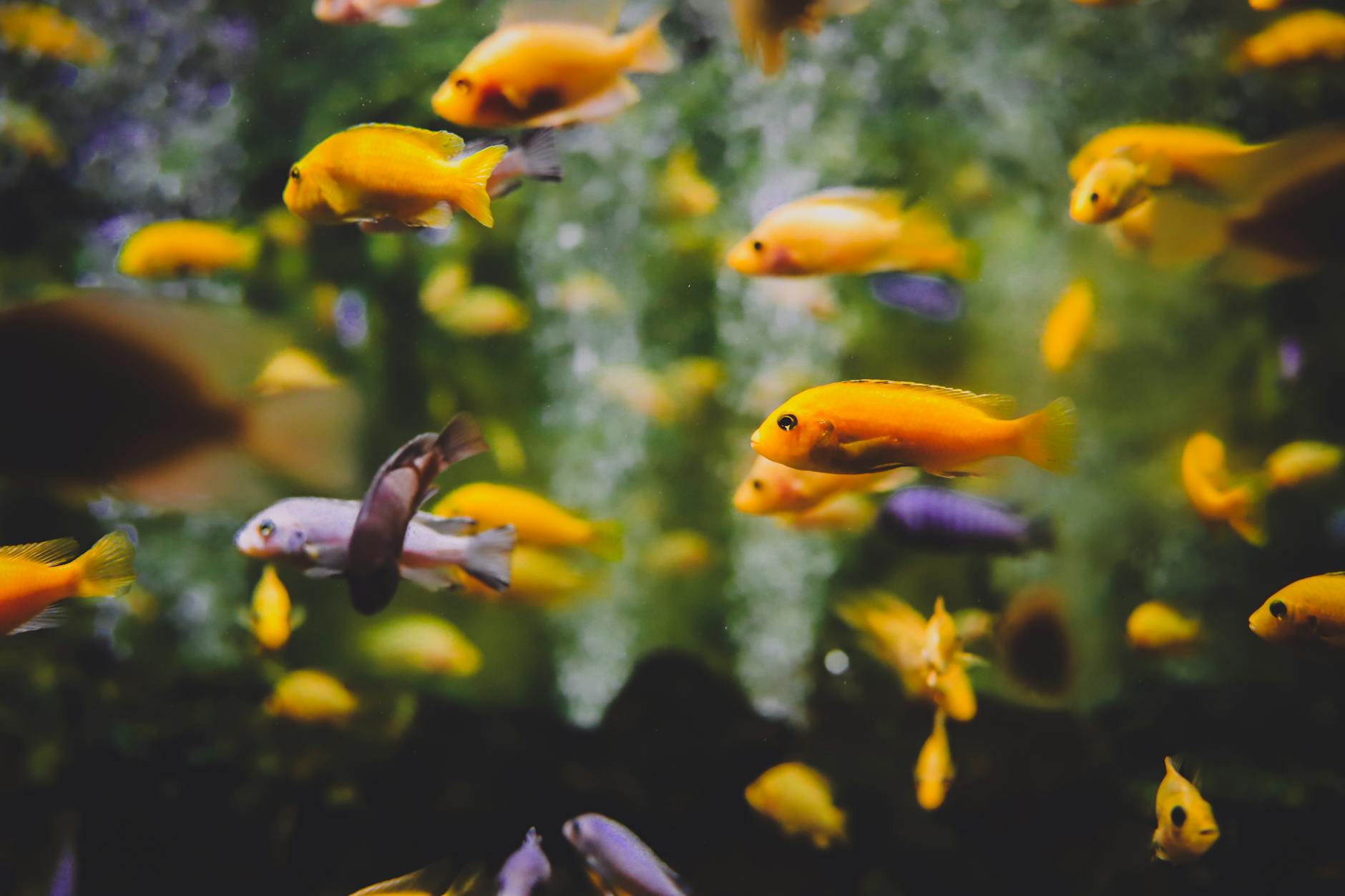
Walking to his apartment down evening streets, he saw several shops littered on the sidewalks. Convenience store, hardware shop, cyber cafe, photography studio, fast food outlet, cosmetics showroom and finally this one decrepit aquarium supply store. They had fishes with colours that the dead fish, mother served for lunch, did not come in. These were not for consumption. Koi could only look at them and think about father. Earlier, he’d be certain that father knew all their names and attributes. But now he knew father only cared about the ones he could eat. Fair enough, he thought.
Several fish tanks, in various sizes, stood on display. Koi contemplated if he had the space. He thought of calling father but ultimately did not, it was way past his current bedtime.
The scales of his boyhood crossed his mind. He had found a way to keep the fish in his life without the fire of his stove.
About the Author:

Mandakranta Das is an undergraduate student from Jadavpur University, department of English. They are a keen student of literature and writer by passion. Their areas of special interest and research include theatre studies, Gender and Sexuality studies, South Asian literature and world literatures.

 The Hemlock Journal
Leave a comment