Besides Haruki Murakami and Orhan Pamuk, Elif Shafak remains one of those remarkable writers triumphing in evoking a strong sense of yearning for the restless but quiet narratives of the cities central to their novels. In this aspect, The Bastard of Istanbul did not disappoint me. Nevertheless, this book did not sit well with my other list of favourites from the same author: The Architect’s Apprentice, The Forty Rules of Love, and Honour.
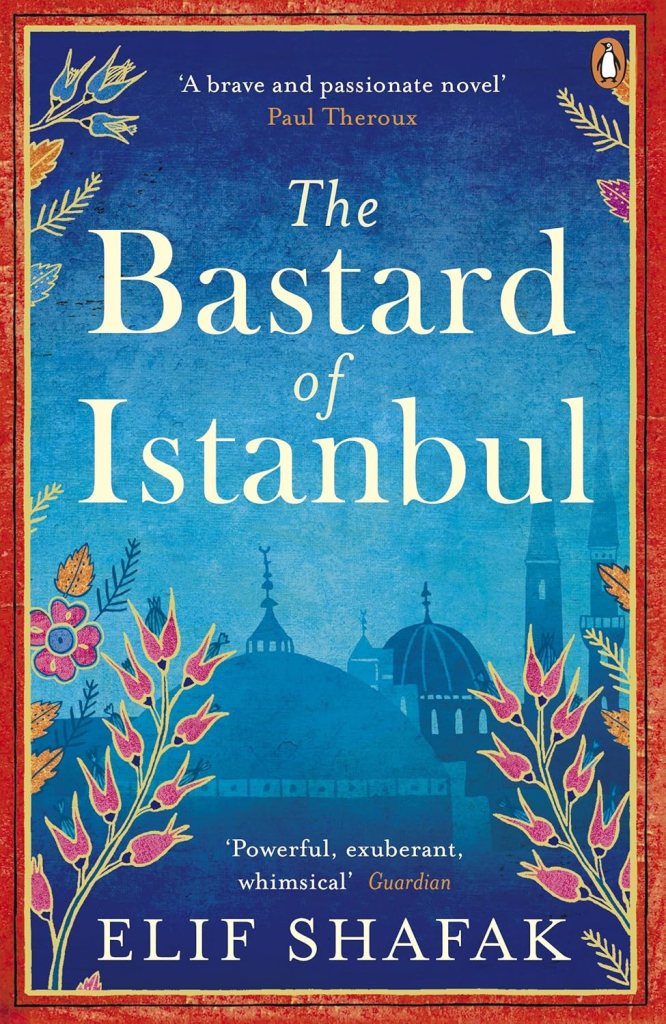
Click Here to buy the book
At its core, The Bastard of Istanbul is about Asya Kazanci—the bastard child of Istanbul (the title doesn’t betray the subject of the novel) —and Armanoush Tchakhmakhchian—the Armenian-American child. Letting the story perpetually grapple with specters of the past [perhaps detrimental, more than fundamental], Shafak focuses on the narratives of the events of the 1915 Armenian genocide, seamlessly characterizing the Turks and Armenians, as aptly remarked in the novel: “For the Armenians, time was a cycle in which past incarnated in the present and the present birthed the future. For the Turks, time was a multihyphenated line, wherethe past ended at some definite point and the present started anew from scratch…”. This prettymuch sums up the premise of the book for me.
Denial of the past also acts as a reminder/apparition of the past. In this sense, every character in this novel is an itinerant (of the past): Grandma Shushan (Shermin 626 and Shermin Kazanci in the past), Petite-Ma (Asya’s grandmother, afflicted with Alzheimer’s), Auntie Banu (the clairvoyant Kazanci sister), Mustafa (stepfather to Armanoush and uncle to Asya), and Auntie Zeliha (the mother of Asya). Similarly, Armanoush and Asya, too, carry the itinerant’sreminiscences from the past. They are portrayed as the crusader of remembrance and the fugitive from the past, respectively embodying the Armenian and Turkish mentality with respect to tackling history. For that matter, the story persistently straddles between the conundrum of either accepting the past or letting the bygones be bygones. But the author is not too keen on weighing between the dichotomies of either/or concept. Shafak simply leaves the readers hovering around another sense of ethical dilemma, as hinted in the novel: Just like the Turks have been in the habit of denying their wrongdoing, the Armenians have been in the habit of savoring the cocoon of victimhood.
The author explores the profound matters of history between Armenians and Turks differently. Shafak quietly weaves the tapestries of shared culinary traditions and practices to intertwine the cultures of the Turkish and Armenian people,inviting readers to traverse beyond the conventional binary.
The novel begins with the section named Cinnamon [I am the cinnamon peeler’s wife. Smell me!]. Similarly, each sections of the book are named according to spices and ingredients, including pistachios, almonds, pomegranate seeds, dried apricots, dried figs, but also water, rosewater, and white rice. Interestingly, these names constitute the ingredients to a popular dessert called Ashure [a detailed description of the recipe is also very well placed in one of the chapters of the novel]. But Shafak sprinkles her own secret ingredient to this sweet in this novel that we cannot find otherwise—potassium cyanide. Ashure without any secret ingredient represents the epitome of survival, but if someone were to add a secret ingredient, it would come to represent the epitome of death.
In the beginning of the story, Armanoush measures one’s Armenian-ness from a given list of hypothetical questions, including “if your dad still peels oranges for you, no matter what age you might have reached”. Certainly, one never doubts Armanoush’s Armenian-ness. But there is a beautiful portion in the novel following Armanoush’s journey to Istanbul, precisely at the ‘konak’ of the Kazanci family.
The scene cultural connection shared between both the Turks and Armenians. Additionally, it is not only a culinary connection, but there are others as well. For instance, the list of hypothetical questions also refers to the perpetual apparitions of the past haunting the present, or “if you have had (orare planning to have) a nose job” (the readers know how much Asya hates her aquiline nose).
In several interviews, the author has referred to herself as a nomad. In fact, this book was apparently written while commuting between Arizona, New York, and Istanbul. The narrative of the novel also traverses between Arizona, California, and Istanbul.
Shafak also mentions her dismissal of the either/or mentality. Somewhere, for me, the writing style of this book is also redolent of a sense of roving (maybe too much) between several storylines and characters. But it also means that the author remarkably materializes the dismissal of the idea of either/or mentality by giving her writing a sense of fugitive-ness necessary to understand the entangled historical events in the lives of Turks and Armenians.
About Reviewer :

Thamanna is a researcher and a writer based in Kerala. Her love for the perfectly placed commas and words in a sentence drives her editorial impulse and appreciation for the language. She also enjoys reading stimulating conversations on books, cinema and art.


 The Hemlock Journal
Leave a comment