I read Anita Desai‘s In Custody (published in 1984) back in 2019. It wasn’t an accidental read; it was one of the books to be read for our post-graduation under the paper Indian Writing in English. I hated this book then. But looking now at those notes scrawled on the page margins of the novel, let me reflect a little on the reason behind it. Rather than a contempt for the book, it was a hatred for confining my pleasure of reading to the exams. The exams are over now. This book effortlessly crawls into the list of one of my favourite novels.
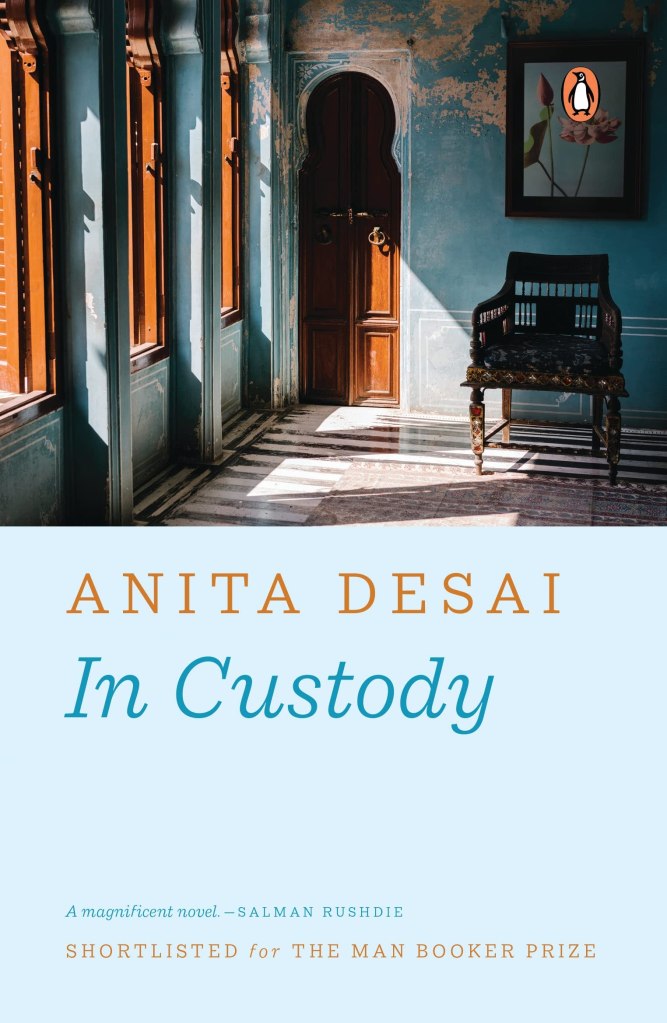
In Custody reads like an elegy on the dilapidation of language. The book seamlessly follows a plotline of etching the dereliction of the language and literature of Urdu, with a sense of urgency to document it. Desai meticulously places it against the chaotic background of Delhi and in contrast with the timid character of the protagonist, unfamiliar with a world outside his town. The story follows Devan Sharma, a timid and reserved Hindi Professor. The title of the book fittingly conveys the portrait of the character, one who is in perpetual custody—to his family, job, and marriage. In fact, similar to the precarious status of languages, Devan too walks along the margins, without being seen, without being noticed, or without saying much (there are very few dialogues, too, in this book). One day, Devan is approached by his friend Murad to record the poetry of the famous but receding Urdu poet, Nur. A lover of Urdu poetry and of Nur, Devan imagines that “the door of the trap had opened and he could escape after all into a wider world that lay outside”. From thereon, the readers are thrust from the quiet and monotonous village of Mirpore to the bustling and derelict walled cities of Nur’s Old Delhi.
Being perpetually in custody of his own tedious and practical life, Devan is confronted by several obstructions throughout the book. Nur is different from Devan or perhaps, different from what Devan imagined his beloved idol to be. As the story moves, Devan realizes that with the dereliction of languages, their custodians, too, are decaying. Can Devan succeed in recording the words of Nur before the language and the poet fade into the corners of memories? However, the readers are left with no answers, and Devan, too, is left with no solace from the readers. The novel prompts us to ask several questions: Who becomes the custodians of receding languages? Or who acts as the custodian of these languages? Is it possible for one to record the memories of foregone times without letting them get erased from history? Or what even gets written into history? This novel deeply reflects on these questions in every chapter.
SUBMISSION OPEN for Fiction Writing Contest. Win Cash Prizes and Dual Publication with The Hemlock Journal and Remington Review. Click Here to Know More.
About the Reviewer

Thamanna is a researcher and a writer based in Kerala. Her love for the perfectly placed commas and words in a sentence drives her editorial impulse and appreciation for the language. She also enjoys reading stimulating conversations on books, cinema and art.


 The Hemlock Journal
Leave a comment