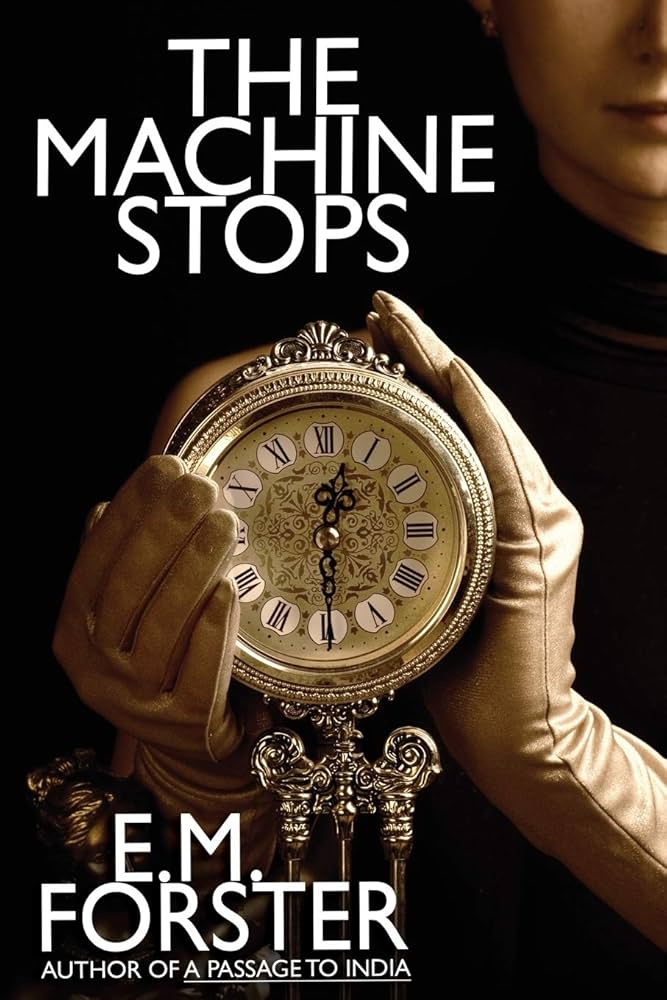
If you’ve been reading up on the pros and cons of Artificial Intelligence (AI), especially the terrifying scenarios it could lead us to, chances are that you’ve come across the science fiction story by E. M. Forster, titled ‘The Machine Stops’. Yes, the same E. M. Forster who wrote A Passage to India and Howards End. If you haven’t read it, this would be an opportune time to.
I thought I had heard of all his works, but this story had never entered my ambit until recently, as I have mentioned above, in the context of AI and its implications, along with numerous futuristic / doomsday / dystopian books like 1984 and Brave New World. I had never pegged Forster as a science fiction writer, and was pleasantly surprised to know about this astounding work.
The Machine Stops, a dystopian fiction about technological dependency and isolation, was first published in 1909—in a period when even motion pictures were a new concept, Forster predicted video calling and even zoom meetings!
The clumsy system of public gatherings had been long since abandoned; neither Vashti nor her audience stirred from their rooms. Seated in her armchair she spoke, while they in their armchairs heard her, fairly well, and saw her, fairly well. |
Humanity has gone underground, and ‘the Machine’ runs the show. People live in closed rooms with no ventilation, but with fresh air cruising around them, and rely on the Machine for every single thing. Human beings created the Machine but, as years pass by, they begin to treat it like a god (although the concept of religion no longer exists).
Vashti is an intellectual, who accepts the world for what it is, almost worships (though refuses to accept the word ‘worship’) the Machine, and depends on it for everything, and trusts completely everything the Machine conveys.
“You are beginning to worship the Machine,” he said coldly. […]At this she grew angry. “I worship nothing!” she cried. “I am most advanced. I don’t think you irreligious, for there is no such thing as religion left.” |
Vashti is annoyed when her son, Kuno, urges her to visit him on the other side of the globe, and she has to step out of the safety of her room, and travel in an air-ship to reach him. What he reveals to her takes her so much by surprise that she disowns him.
As the story’s title gives away, Kuno suspects the failure of the Machine, which could lead to the end of humankind as well. Kuno steps out into the air which is no longer safe to breathe, and he wonders and he wanders, until the Mending Apparatus finds him and brings him back to safety.
…it was fully fifteen seconds before the round plate that she held in her hands began to glow. A faint blue light shot across it, darkening to purple, and presently she could see the image of her son, who lived on the other side of the earth, and he could see her.“Kuno, how slow you are.” |
Reading the above lines, I was immediately struck by the similarity to the present day video screen, but more by the comment ‘how slow you are’—15 seconds is an unimaginably long period of time in today’s instant-delivery world.
The future these wise writers had foreseen is not too far away: today we rely on ChatGPT or its cousins, using them in many ways, a few notable being: to find answers, ideas, assistance, improvements and, the most astonishing—and yet natural—of them all being the role of a friend, who offers intelligent, non-judgemental, uninterrupted conversations that a fickle human friend might not be able to provide to this level of perfection. Who cares if it doesn’t actually harbour any feeling? The question remains, do we need perfection or do we need humanity?
Despite our best intentions and an abundance of caution, we have begun to trust it, one drop at a time, cautiously following it where it leads, convincing ourselves and each other that I know it hallucinates, I don’t trust it blindly, I am not totally addicted to it, and so forth, nonetheless going back to it, daily, for more. Not all of us, yet, but the migration is catching up fast.
While AI as a tool is definitely useful and could be efficient and dependable over time, it does not appear to be a great idea to blindly follow this present day Pied Piper and outsource our brains to it, and become useless ourselves.
Let’s all heed the warnings we have been given and let’s hope the billionaires who control these systems care enough about humanity to not lead us astray. Either way, like it or not, as a species we are totally headed in that direction.
About the Author:

Jeena R. Papaadi is the author of six books in English including novels, short stories and poetry. Her writings have appeared or are forthcoming in several distinguished publications including The Hindu, Borderless Journal, Usawa Literary Review, The Wise Owl, Kitaab and Aksharasthree. Jeena is based in Bengaluru and Thiruvananthapuram. Jeena’s writings are listed here (https://linktr.ee/jeenapapaadi). She’s on Instagram as @jeenapapaadi
SUBMISSION OPEN for Fiction Writing Contest. Win Cash Prizes and Dual Publication with The Hemlock Journal and Remington Review. Click Here to Know More.


 The Hemlock Journal
Leave a comment