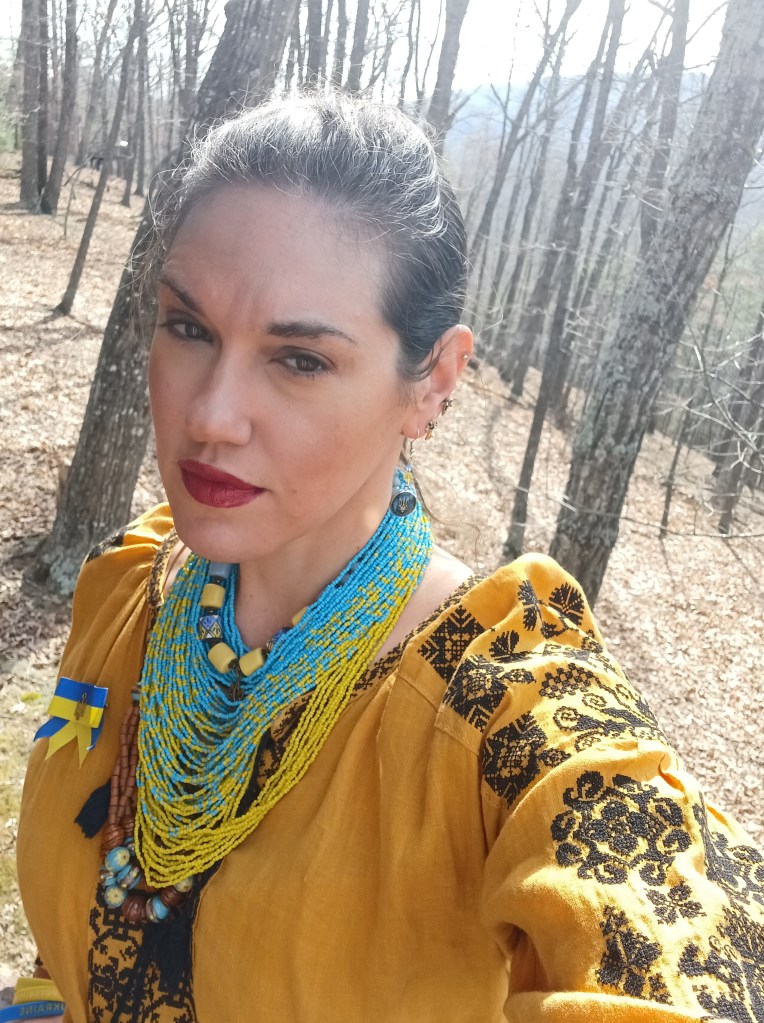
Nicole Yurcaba was among the poets whose poems were shortlisted from The Poetry Writing Contest 2025 organized by The Hemlock Journal. Her poem ‘Valentine’s Day’ secured 2nd position and was published in the ‘Special Poetry Issue’.
To read ‘Valentine’s Day’ and the other 24 shortlisted poems, BUY the Special Poetry Issue: Click Here.
“Love is showing up for those you care about.”
Interviewer: Congratulations on being one of the winners of the Contest. Could you tell us a little about yourself and your journey with poetry?
Nicole: My name is Nicole Yurcaba (Nikola Yurtsaba in Ukrainian), and I am a Ukrainian American poet and professor. I have always loved poetry, but during high school I became particularly drawn to it because of the goth rock and heavy metal I listened to. One day, I picked up a pen and journal and thought “Well, I can do that,” and I never stopped writing. I pursued publication—successfully—during my undergraduate years, and I continued my poetic journey into my adulthood as an academic, a daughter, a caregiver, and an artist.
Interviewer: What inspired you to write your winning poem? Was there a particular moment, memory, or feeling that sparked it?
Nicole: In September 2024, I’d experienced a severely painful break-up. In October 2024, my father fell ill, and we embarked on the journey that would be the last few months of his life. In June 2025, I was traveling to Greece for the Aegean Arts Circle writing workshops, experiencing a melee of complicated feelings about my ex, my father’s death, and this poem just came pouring forth. What if I texted my ex and told him how I felt? However, how I felt wasn’t what I wrote in the poem. The romantic element, even the dead lover’s character—I added those to create an air of mystery and melodrama.
Interviewer: Since the theme was Love, how do you personally define or understand love? Did that definition shape your poem?
Nicole: When I think about love, I always return to a saying I recently heard when I attended a wedding in May 2025 with my best friend from college: “Love is showing up for those you care about.”
Interviewer: Do you remember the very first poem you ever wrote? How does your writing today compare with that early attempt?
Nicole: I’ve been writing poetry since childhood, and I believe my first poem was about our family dog, Mandy, having to go to the vet.
Interviewer: Which poets, writers, or artists influence your work the most?
Nicole: I’m definitely influenced by writers like Serhiy Zhadan, Oksana Zabuzhko, Artur Dron’, Yuliya Musakovska, and Olena Boryshpolets because of our mutual Ukrainian heritage. However, I cannot deny that Kafka has influenced the more depressive elements in my writing, and TS Eliot surely has influenced my experimentation with fusing classical and linguistic allusions into my work.
Interviewer: Do you think poetry still holds power and relevance in today’s fast-paced, digital world?
Nicole: Yes, because now, more than ever perhaps, poetry is a necessity. It’s the vehicle for cultural preservation, witness, documentation, and so much more. I think, if given the chance, poetry has a way to unify people. For example, I see this when I visit Ireland and attend the John Hewitt Society International Summer School, where—because of a single poem someone’s read—the room is quiet and filled with a strange, unifying energy. I also see this is a Ukrainian American. Since 2022, poetry has become this thread that ties so many of us together, keeps us bound to one another, and reminds us of our cultural, linguistic, and historical identity and legacies.
Interviewer: As a poet or writer, are you afraid of the rise of AI generated content? How do you think the writing community survives against the tide?
Nicole: Yes, because I fear it’s too easy to use and too accessible, and humans really are pretty irresponsible. The human brain is the most wonderful computer. People just have to learn to use it and stop letting labels and society’s boxes inhibit them from exploring all aspects of themselves. A computer or AI can’t live one’s individual experience—which is a beautiful (often painful) gift. AI can’t replicate that. I think it is up to writers and artist to continue to value, to practice, and to emphasize the importance of natural creativity.
Interviewer: What advice would you give to emerging poets who want to write about big themes like Love without falling into clichés?
Nicole: Don’t be afraid to be specific. It is those specific experiences, details, images that define your experience, your emotions, etc. This means be observant. This means taking notes, being raw, and even being unfiltered. It’s very cathartic to avoid cliches, because cliches do not capture YOUR individuality and self-expression.
Interviewer: What projects are you currently working on, or what can readers expect from you in the near future?
Nicole: I’m currently finishing the manuscript in which “Valentine’s Day” appears, but I’ve also embarked on a new, surprisingly happier set of poems inspired by a recent trip to Ireland. I also continue to write book reviews about Ukrainian literature in translation in order to raise awareness about the war in Ukraine.
About Nicole Yurcaba
Nicole Yurcaba (Нікола Юрцаба) is a Ukrainian American of Hutsul/Lemko origin. Her poems and reviews have appeared in Appalachian Heritage, Atlanta Review, Seneca Review, New Eastern Europe, Euromaidan Press, Chytomo, and The New Voice of Ukraine. Her poetry collection, The Pale Goth, is available from Alien Buddha Press.


 The Hemlock Journal
Leave a comment