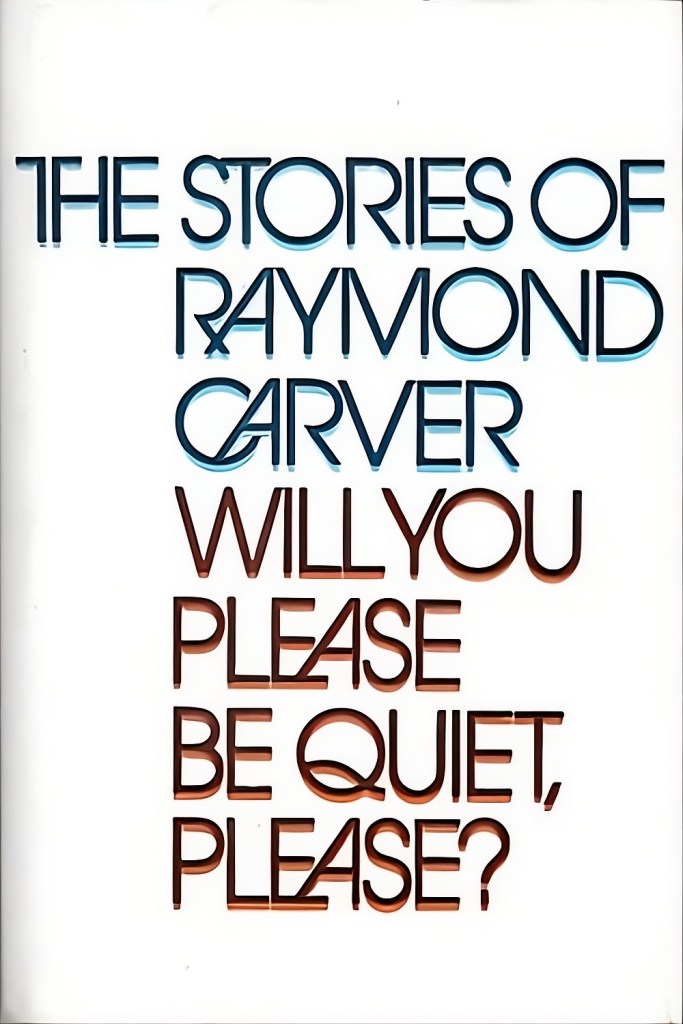
Will You Please Be Quiet, Please? is a collection of short stories by the American writer Raymond Carver. (I am new to Carver’s stories, but the title alone was enough to hook me onto this collection). The title echoes a dialogue from one of the short stories, the final one. It made me curious about the tone of redundancy in the question asked. Why did whoever had said this line implore that someone to please be quiet? Why did it have a beseeching tone, or rather, an annoyed tone, or perhaps, is it a voice politely demanding the readers to quietly read along the stories and pause and listen? In the titular short story, the dialogue reflects a tone of plea for quietness uttered by the husband following a confession from the wife on her infidelity. And therein, on an enormously happy and quiet Sunday night in November, a moment of crack appears in their lives. But the story ends on an ambiguous note: whether the husband can forgive the wife or not; whether there is a possibility of a second chance in their supposedly married life; or perhaps, asking the readers to think of themselves in the place of the husband to quietly consider what they would do in such circumstances.
Carver’s stories are abundant with ambiguous moments, heartbreaks, doubts, desperation, curiosity, hope, moments of loneliness, of letting go, and contemplation. But these moments only appear briefly. His stories are described as inclining towards brevity. And indeed, before they begin, they end with an abrupt tone of narration. The characters could be a husband and wife, or a boy, or a salesman, or a doctor. The first short story is called Fat. The story describes the narration of a waitress encountering a customer who happens to be really fat: “This fat man is the fattest person I have ever seen”. The waitress goes on to describe his thick fingers and sounds of huffing and puffing, but serves him with utmost respect. Later on, she wonders what it would be like to have a child as fat as the man. But the encounter with the fat man feels strange for the waitress, and the story ends with a note on how she feels that her life is going to change following the strange encounter with the man.
The second story in this collection of twenty-two stories is called Neighbours. It is about a couple named Bill and Arlene Miller. They promise to watch over the house of their friends as they go away for a short trip. This turns into a strange story of finding joy in voyeurism. For the Millers, house-watching becomes an activity of a desperate effort to impersonate the much brighter life of their friends; a desperation to substitute their own feeling of boredom and loneliness. We see Bill Miller going over to the friends’ house in the name of looking over the house: “He opened the closet and selected a Hawaiian shirt. He looked until he found Bermudas, neatly pressed and hanging over a pair of brown twill slacks. He shed his own clothes and slipped into the shorts and the shirt. He looked in the mirror again”. But this ends as Arlene forgets the key to the house inside and therefore, ends their journey of voyeuristic joy. This is only one of the strange stories from the collection with a narration as intense as this.
The short story called Put Yourself in My Shoes is about a writer named Myers and his wife, Paula. On Christmas Eve, they decide to meet their former landlords, the Morgans. Their conversation begins with hot drinks and anecdotes recounted by Mr. and Mrs. Morgan. With each story, they ask Myers to put himself in the shoes of the characters of the story. One such story involves an account hinting at Myers’ own story during the time he stayed at their house. The Morgans had leased out their house for a year or so, during the time they were gone to Germany. They subtly (or rather overtly) accuse Myers of disrespecting their boundaries and vandalizing their personal possessions including unlocking their closets, sleeping on their beds, and breaking their dishes. But Myers only reacts with laughter. As they leave Morgan’s house, we read the ending line of the story describing that Myers was “at the very end of a story”.

Each story is quite different from the other. This acutely echoes the authors’ rejection of categories. It would be wrong to find a common plotline to these stories and put them into a single thread. For example, there is a story called Are You a Doctor?. It is a story about a man receiving a call from a random number of a woman, who apparently got it from the sitter who noted down the number. They are strangers, and yet the woman thinks they should meet up. They meet up, but nothing significant happens, and before it can happen, the story ends. The Father begins with the birth of a baby. As the family surrounds the baby, they contemplate the facial features and try to understand who he looks like. They say, “He looks like Daddy”. But then, who does Daddy look like? And they unanimously say, “Daddy doesn’t look like anybody”.
I stumbled upon Carver’s lines from the poem In Switzerland at the 2026 Kochi-Biennale. It was carefully placed next to a collection of paintings called “All of Us”. The title of the collection echoes the lines from Carver’s poem: “All of us, all of us, all of us/ trying to save/ our immortal souls, some ways/ seemingly more round-/ about and mysterious/ than others. We’re having/ a good time here. But hope/ all will be revealed soon”. The paintings feature large landscapes of crowded figures and reflect precisely on breakdowns and uncertainties. Several stories in this collection reflect a desperation to discover something curious to substitute for, perhaps, unhappiness, such as the voyeuristic experience, the curious story of the fat man, or the gossiping travellers in a town upon the arrival of a new family. These stories speak of brevity but also leave a space for possibility and contemplation; maybe the neighbours won’t come back, maybe they will move to the country, maybe they have a chance at reconciliation, maybe they have a second chance at their marriage. There are indeed brief moments of disquiet, breakdowns, and uncertainty, but there could also be brief moments of quiet happiness.
About the Reviewer

Thamanna is a researcher and a writer based in Kerala. Her love for the perfectly placed commas and words in a sentence drives her editorial impulse and appreciation for the language. She also enjoys reading stimulating conversations on books, cinema and art.


 The Hemlock Journal
Leave a comment