Writing is a unique art. It is one of the few arts where there is no recognition for exact reproduction simply because most of the human race is skilled at reproducing writing. A musician has to train for years before they can reproduce a moderately complex tune. An artist has to practice for years before they can produce a copy of a popular painting. But thanks to the revolution engineered by Gutenberg and his printing press, reading and subsequently writing have become so ingrained in our education that anybody can reproduce a passage from a popular book or even an entire book. The only aspect of reproducing writing that can be appreciated is the labour involved in it and if perhaps done by a calligraphist, the fonts and styles.
Therefore, a writers’ art purely depends on their skill of innovation. In Indian Classical music, there are two aspects of a performance. The precise reproduction of popular melodies and the extempore rendition of music called Manodharma in Carnatic music. A writer’s performance relies solely on this extempore performance. A writers’ dharma or order is solely their Manodharma, on this order of the mind.
Hold that thought for a moment.
There is no word today that occupies our quotidian pontifications and ramblings more than AI. If it’s not someone joking about the hilarious shortcomings of AI, it is a mad prophet predicting the end of the world from their digital pulpit. I work in a field that is deeply tangled with both the cause and effect of this AI. So, I speak with a grain of authority and state that AI, specifically Large Language Models with their extended ability to manage other softwares (and by extension the hardwares that the softwares has access to) is a non-deterministic pattern prediction and generation software with a massive memory. It can reproduce human patterns and this reproduction is inconsistent by design.
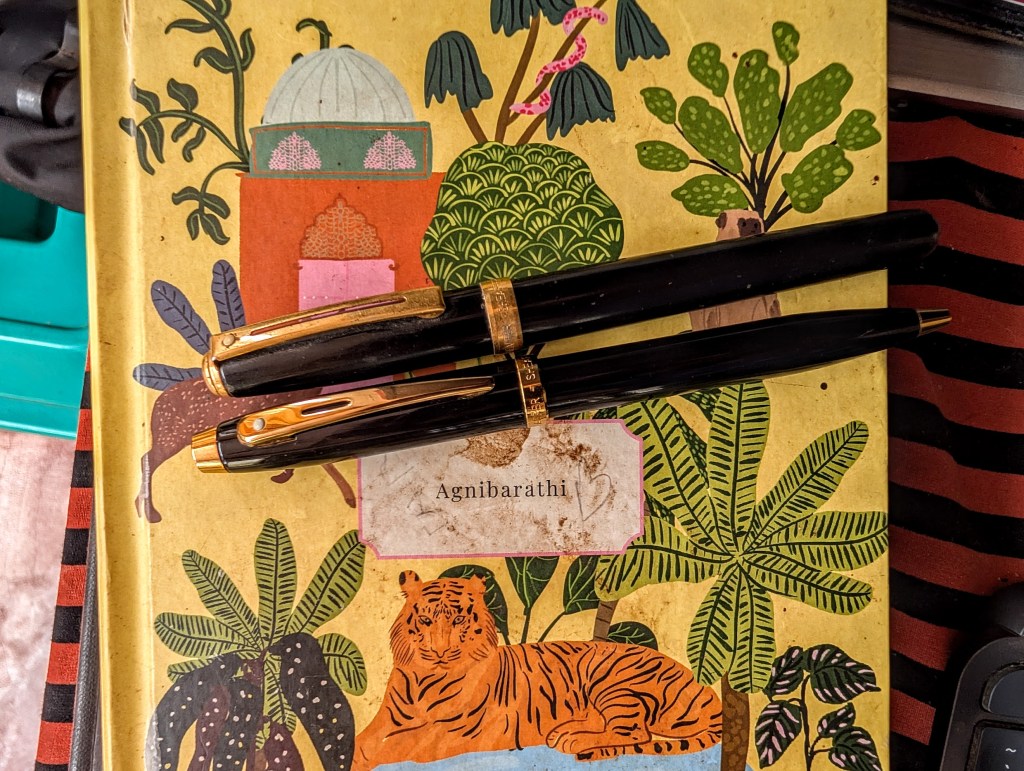
Now, go back to the thought that I wanted you to hold – “A writers’ dharma or order is solely their Manodharma, on this order of the mind.” If the sole reason an art is appreciated is because the artist must produce extempore output using their skill, then that art is automatically safeguarded against a system of reproduction, no matter how sophisticated it is. AI can replicate writing patterns and styles. It could possibly generate 75,000 word novels in an hour. But reproduction was never the hard part with writing as an art. Nobody pays (both money and appreciation) to read a variation of a pre-existing style. Yes, we desire to similar patterns; we relish the almost clockwork like P G Wodehouse humour, the recurring Tagore-ian motifs of boats moored in lakes under gathering clouds, the almost conjured up incantation-like prose of Arundati Roy, the surgically chosen vocabulary combined with an unexpected culinary warmth placed in the utterly incongruous murder mysteries of Kalpana Swaminathan.
But our reading delight is not purely based on these patterns being reproduced meticulously. The reading and therefore, the writing experience arise from the use of these patterns of style and form being used in never before used ways. This kind of creation requires genuine sentience and conscience. If AI develops such conscience and sentience, undergoes lived experiences, and genuinely writes, then we must welcome it as the dawn of a new consciousness and learn to coexist with it. However, I believe AI as we know it now is a long distance from achieving the magic of sentience, even though it mimics it in scarily accurate ways.
So, the potential of AI arising as a new species of consciousness notwithstanding, what does the advent of AI, as a paradigm shifting tool mean for us writers? Here are my predictions.
The creation of slop or pulp writing will get easier. This creation has existed since the dawn of writing. Penny dreadfuls, yellow-backs, and pulp magazines have not just been common, they’ve given rise to some memorable characters (like Sweeney Todd). The simplification or even automation of this writing is a welcome change. We needn’t judge those who consume mass-produced writing any more than we judge those who consume mass-produced movies, food, or any other form of pleasure. Their function is to entertain and not elevate. The rapid production of such entertainment, not just in the form of writing but in other art forms will only delineate the differences in quality further.
To the professional writer, the one who feels not just the desire for wealth, fame, or even eternal glory through writing, but to the one to whom writing is the hunger that gnaws at his bones, a perpetual plague that forces him to retch up the written word and the numerous worlds it creates almost against his will, AI will only become a boon. The mania that is both a blessing and curse of the human writer will never afflict the AI tool. And therein, as the bard put it, lies the rub.
For, we are blessed and cursed with conscience, and conscience will make cowards of us all, compelling us to experience the slings and arrows of outrageous fortunes and take pens (or computer keyboards) against a sea of troubles and thereby express our thoughts in words. To experience – to express.
For in that malAIse of expression, what tales might come?
(Creative non-fiction by C S Sriram (aka) Agnibarathi 2025, all rights reserved. No part of this work may be reproduced without prior permission.)
About the Author
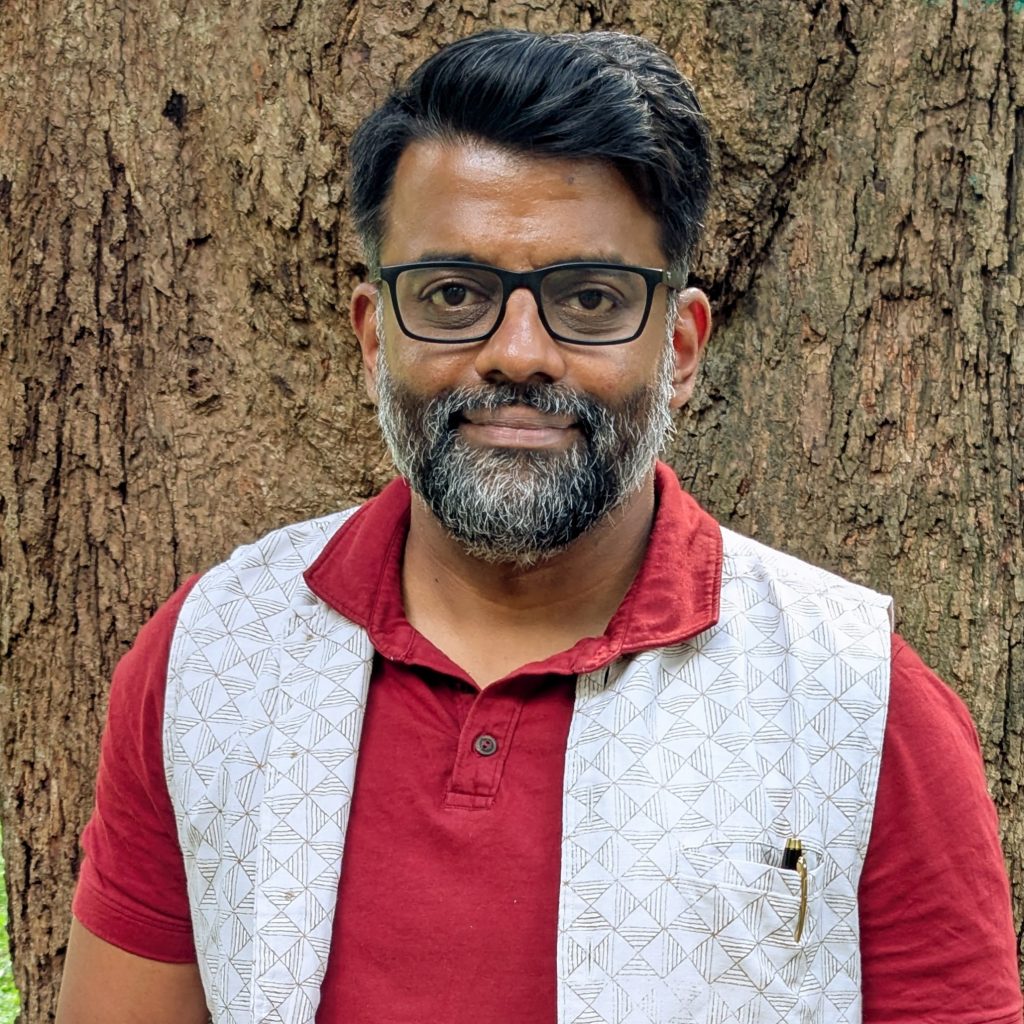
Agnibarathi is a writer, poet, and software engineering executive whose work frequently explores the intersections of nature, mythology, and social philosophy. His writing has appeared in publications such as The Madras Courier, Ethos Literary Journal, Muse India, and The Chakkar. He was recognized in The Hindu Lit for Life 2025 for his short story “How the Spider Found Her Home,” and his debut poetry collection, Hymns for Loving and Longing, is forthcoming from Red River Press in 2026. Deeply influenced by Classical Tamiḻ literature and an ethos of ethical veganism, Agnibarathi seeks to subvert traditional narratives to examine modern privilege and our relationship with the natural world.




 The Hemlock Journal
Leave a comment