Stilt-Walking Through Minefields
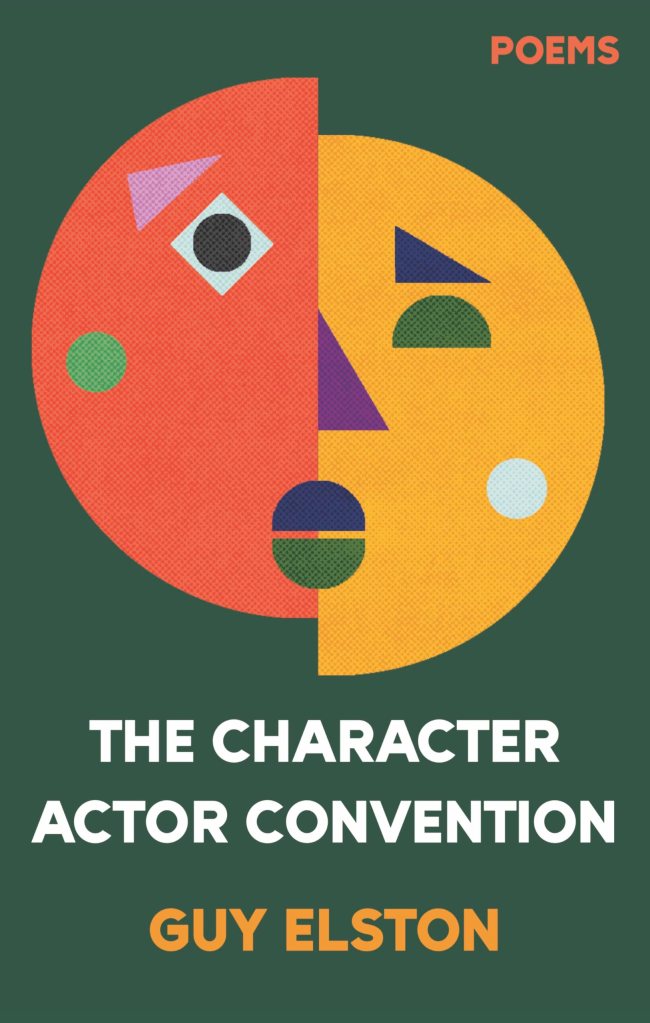
Guy Elston. The Character Actor Convention. The Porcupine’s Quill, 2025
A character actor, according to the Oxford Dictionary, is “an actor who specializes in playing eccentric or unusual people rather than leading roles,” and a convention can be either “a large meeting or conference” or “a way in which something is usually done, especially within a particular area or activity.” Put them all together and you have Guy Elston’s debut poetry collection, The Character Actor Convention, a book where the eccentric and the unusual meet together to undo what is usually done. In the poem “Instrument” even the word “life” is upended to signify its opposite: “I killed a spider with Keith Richards’ autobiography, / Life. I used the spine, holding the book sideways, / swinging it down on the exoskeleton / with more than enough force. The spider tensed, / then relaxed like a glove, bunched itself neatly.”
One of the book’s numerous strengths is how the poems optimize the speculative nature of poetry. First-person speakers include a prize pumpkin, a songbird, hydrogen, a stick insect and many other unusual narrators. Chronological timelines are shuffled, the laws of physics are turned inside-out. “Before and after are always / but this instant” (“Post-War”).
Elston makes full use of a juiced poetic licence to explore fresh perspectives, but still anchors the material to authentic human experiences. Several poems include brief italicized epigraphs, lifted from various media sources, directly connected to the poem’s themes. “Police horses undergo ‘creepy’ training / to prepare for Halloween (“Halloween Training for Horses”), “Mystery remains over how sunflowers track light” (“Test Subject”). These quotations have the benefit of presenting a “strange but true” bedrock, a foundation which allows Elston to leap and reach even stranger realms.
What I admire most about this book is the way it presents signs of modern disillusionment as a helpful reminder of the real, the genuine, and the ache that comes from such revelations: “Ice cream doesn’t resemble itself in photos, / they use mashed potatoes instead. / That hurts (“The Work”). There is also a wonderful acceptance of human bewilderment: “She assures me the only universal human word / is huh? / Sounds right” (Dead Pheasant at Casa de Montejo”).

A general risk associated with whimsical, playful poems is that the work may occasionally feel skittish or frivolous, but Elston’s attention to craft, along with his curious empathy, keeps things grounded and lasting. The poems are sure-footed on the page, with word choices and line breaks thoughtfully considered. At first glance, the poems may appear like a dinner thrown together with haphazard ingredients and random pinches of this and that, but the meal is measured, the flavours balanced. If there is a lightness here, it is a lightness of touch, rather than consequence.
I’m often surprised, during such unpredictable and uncertain times, that poetry isn’t more preposterous, more bonkers. Elston’s poems are zany in the best way, amusing and wild and daring, as if stilt-walking through minefields. The book’s eccentricities help shift our attention to the peripheries and fringes we often overlook. In this remarkable debut, the overlooked are seen, celebrated, and ready for their new close-up.
About the Reviewer

Jason Heroux lives in Kingston, Ontario, Canada. His recent poetry collections include “Like a Trophy from the Sun” (Guernica Editions, 2024), and “Unfinished Wilderness” (Anvil Press, 2026). He was the Poet Laureate for the City of Kingston from 2019 to 2022.




 The Hemlock Journal
Leave a comment