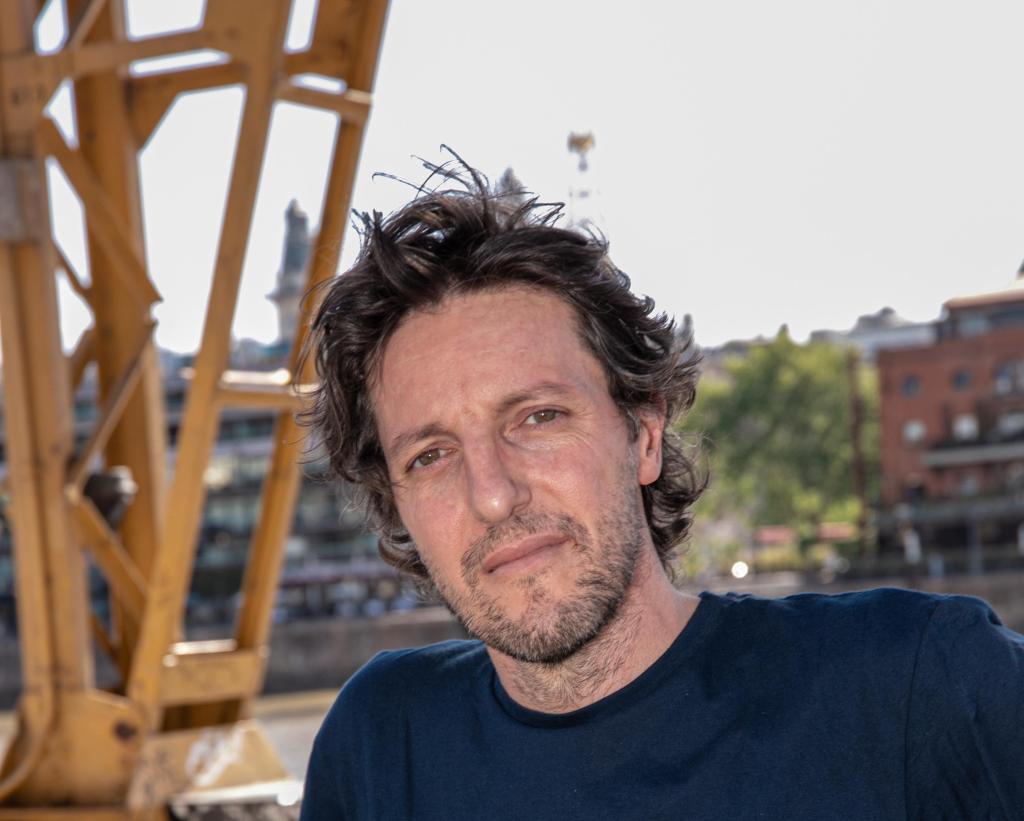
Alan Talevi was among the writers whose story was shortlisted for the Fiction Writing Contest “Call of the Wild” organised by The Hemlock Journal in collaboration with Remington Review. His story ‘First Principles’ secured 4th position and was published in ‘Fiction Special Issue — Call of the Wild’.
Watch Full Interview with Alan Talevi on The Hemlock Journal’s YouTube Channel
I believe there is almost nothing in the world that fosters imagination as much as reading and writing. There’s a fundamental difference there compared to any audiovisual medium. To imagine, etymologically, is to produce images—mental ones. In film, that doesn’t quite happen: the images are given to us, we’re presented with the filmmaker’s vision. Reading, on the other hand, makes you generate your own vision; it trains the muscle of imagination.
Interviewer: How do you decide when a piece of fiction is truly finished, and what role does revision play in capturing the story’s emotional core?
Alan Talevi: Although I do believe that a text is never truly finished—and in fact, whenever one of my pieces is republished, I usually introduce some changes—there are moments of what we might call convergence, when adding or removing anything can substantially alter its meaning. Very occasionally, you sense that the text has reached a certain completeness, a kind of roundness or even “sphericity.”
That said, I tend to think of a text as something alive, open to change and mutation, and the idea of a definitive “closure” or final version strikes me, most of the time, as rather arbitrary. A text often comes to an end because of external constraints—a deadline, for instance—or because the author lets it go emotionally, as the initial drive or momentum behind it runs its course. In my case, the emotional core of a text is usually clear to me, and revision is about achieving the right degree of opacity: the emotional core should remain visible without being underlined.
Interviewer: In your experience, how does well-written fiction encourage readers to slow down and engage more deeply with the world around them?
Alan Talevi: Well-written fiction usually draws you into silence. It makes you pause. And afterward it stays with you—it keeps working on you in delay, opening up layers of meaning.
There’s a Peruvian poet I greatly admire, Mario Montalbetti, who has a poem that says the difference between language and a cow is that if a cow is in a field and wants to go to the barn, it simply crosses the field and goes to the barn—but language can’t do that. Language circles around, it says and doesn’t say, sometimes it says without saying.
In the case of fiction, I think its power lies in the scene. Scenes are moments where actions and relationships are condensed, where characters truly take on substance—they become real, rather than mere narrative functions. Fiction is powerful not because it simply accumulates information, but because it produces fictional truths that generate empathy or antipathy—or, ideally, both at once. It produces inner conflict.
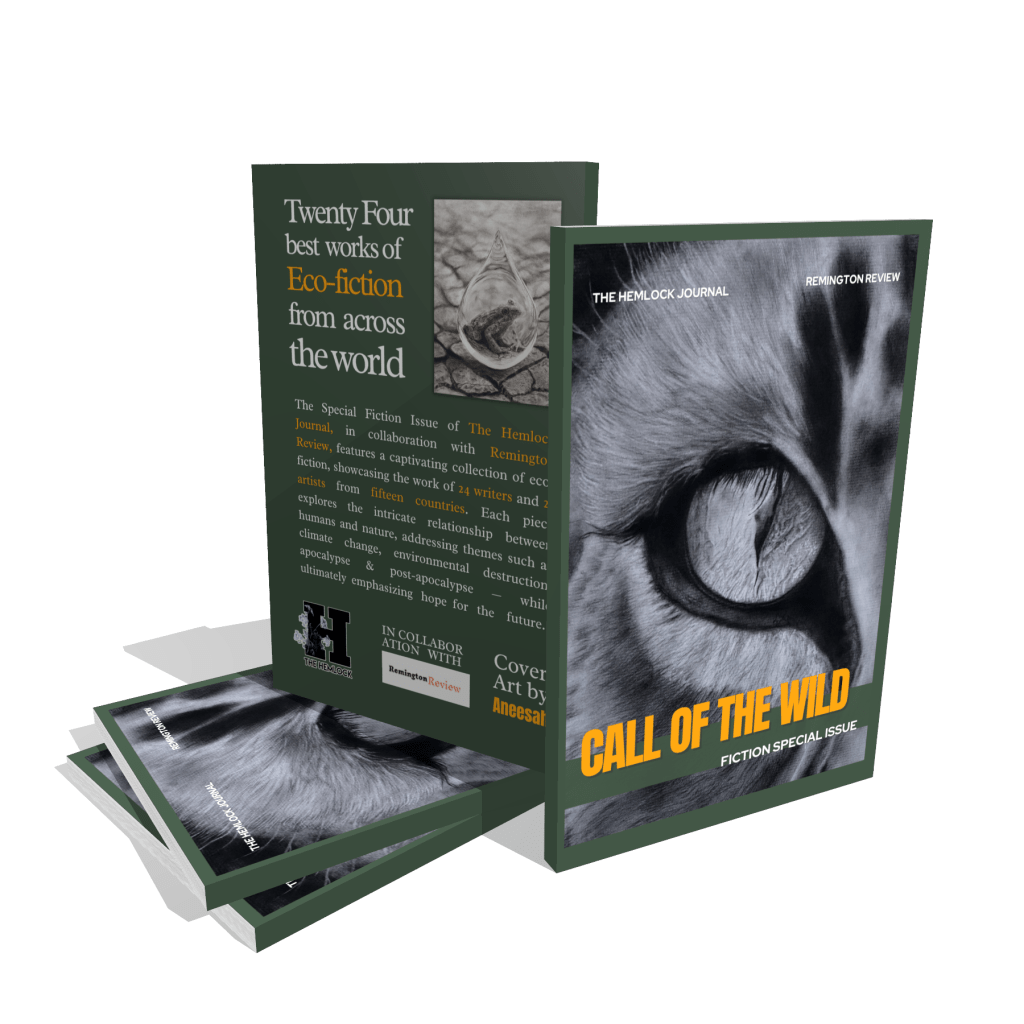
Read ‘First Principles’ and the other 23 stories included in the special issue. BUY the Fiction Special Issue — Call of the Wild: Click Here.
Interviewer: What is one unconventional technique you use to build tension or character depth that might surprise other writers?
Alan Talevi: I wouldn’t say it’s an unconventional technique, but I’m very drawn to works of narrative where, for instance, you build a source of empathy with a character who ultimately turns out to be a monster. In those cases, fiction reveals the dangers of empathy—the ways in which language can ensnare us.
Perhaps that’s why, in the world, those with a vocation for power often tend to promote forms of “impoverished” language, such as certain social media. People who engage deeply with texts, on the other hand, tend to develop a kind of immunity to manipulation: they understand its mechanisms, having been exposed to them time and again. So I enjoy both writing and reading texts that, in one way or another, unsettle our moral expectations—texts that place us in a state of inner conflict.
Interviewer: What recurring themes pull you back to the page, and how do you hope they resonate with readers today?
Alan Talevi: I suppose deception, betrayal, and downfall are themes that interest me. And also their antithesis: stoicism under adverse circumstances. Zygmunt Bauman, I think, wrote something along the lines that the only way to protect ourselves from unethical behavior is to carefully examine its possibility—to accept it as a possibility within ourselves. If a better world is possible at all, it cannot be built from a place of superiority, but rather from acknowledging the ever-present possibility of our own failure, of collapse. I’m interested in vulnerability. Perhaps in about half of the pieces I write, children play a significant role.
Interviewer: How has the act of writing fiction changed your own perspective on human relationships or society?
Alan Talevi: I think that, at a deep level, writing and reading fiction have helped me accept my own flaws and judge others less—to understand that no one is exempt from stumbling, from failure. I think that, thanks to fiction, I’m more inclined to forgive. And to forgive myself.
Interviewer: In a fast-paced world, what do you believe fiction offers that other mediums like film or social media can’t?
Alan Talevi: I believe there is almost nothing in the world that fosters imagination as much as reading and writing. There’s a fundamental difference there compared to any audiovisual medium. To imagine, etymologically, is to produce images—mental ones. In film, that doesn’t quite happen: the images are given to us, we’re presented with the filmmaker’s vision. Reading, on the other hand, makes you generate your own vision; it trains the muscle of imagination.
Perhaps, then, generative AIs that produce images for us on demand pose a certain risk. I worry that the muscle of imagination may begin to atrophy the more we outsource the production of images—and, with it, our own capacity for representation. Reading and writing turn us into active makers of images. And, as I mentioned earlier, I think the retroactive effect—the delay in the emergence of meaning—is stronger in the reading and writing of fiction than in other activities, because meaning is less pre-digested.
Interviewer: Describe a “eureka” moment from your writing life that shifted how you approach storytelling.
Alan Talevi: Mmm. When I realized that, especially in first-person narratives, even when the information needed to form an objective view of the narrator is explicitly present in the text, we still tend to empathize with them simply because that’s how the mechanisms of empathy work. In other words, that empathy has less to do with objective values than with narrative and emotional response.
Or when I discovered that, in a state of flow, we produce texts whose origins we don’t fully understand and don’t entirely recognize as our own—texts that can surprise us as if they came from someone else.
Interviewer: What advice would you give aspiring fiction writers struggling with self-doubt or rejection?
Alan Talevi: Keep writing—and, above all, keep reading. Maintain a daily practice of both. Find and explore the themes that truly matter to you. Don’t self-censor. Write texts that unsettle you, that make you feel a certain discomfort when you read them aloud in public.
Interviewer: What is next for you: any dream projects or genres you are itching to explore?
Alan Talevi: I’m very eager to devote myself to a series of essays on time that I’ve been sketching. Paul Ricœur said that narrative—any narrative—is a metaphor for time. I want to write texts that can host even the most far-fetched scientific theories about time and set them in dialogue with the ways narrative and philosophy have approached the temporal phenomenon.
About Alan Talevi
Alan Talevi was born in Buenos Aires in 1980. He holds a PhD in Natural Sciences and a degree in Creative Writing. He has published three short story collections and a novel. He is one of the founders of the Argentine publishing house Salta el Pez.



 The Hemlock Journal
Leave a comment