Just as the autumn leaves fall crisp and brown onto the earth after completing their lifetime, grief, in a similar way, accompanies me as I faced one of the major losses that has shaped my family and me. Yet it slowly gets back to normal by hoping around the corner just like the fresh gush of wind after a hot sunny afternoon. Last year, in September, when I was headed towards Siliguri for my coaching classes after the funeral ceremony of my grandmother in the summer. My grandma reminds me of how outspoken and ambitious woman she was, who led our Breemu (a Lepcha clan in Sikkim) family until a fatal illness gripped her to death. Looking back to the days from where all the branches of our family started, to the vivid flashes of memories hitting back. Pakyong, my ancestral homeland, is one of the main east district towns of Sikkim. The name was derived from a Lepcha word “Pay yong” (which means bamboo of the bow). Growing up, I was always interested to do research and contribute to my roots and bilingual culture hence writing was one of the forces that has pushed me through. So I took this project forward and went around interviewing my family, collecting their perspectives, their fragile memories of childhood with the Haat and the small family business of black cardamom cultivation, which was a great source. Still I feel that grief is embedded deep within all of us. There is this subtle feeling of lost yet we try our best to normalise things and get back on track by not forgetting our ancestor.
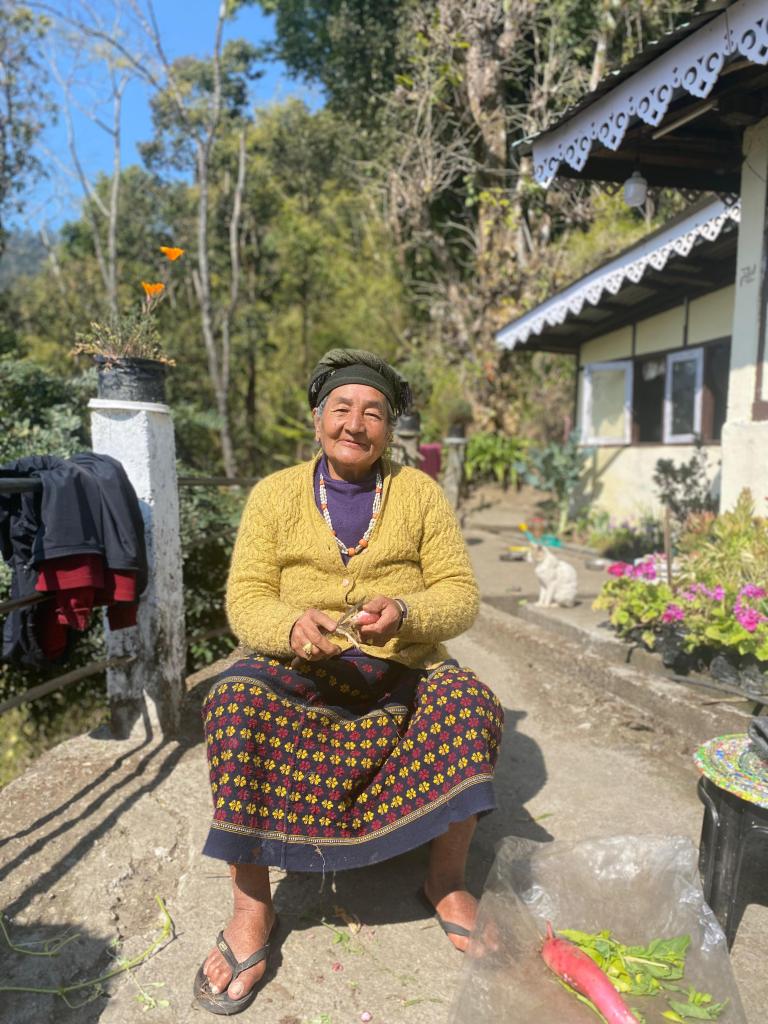
My grandmother, Farasay Breemu Lepcha, had very distinct Mongolian features, a brown-skinned (due to Pakyong heat) woman having a pair of big eyes and a pointed nose, who always observed over to the people who passed by. A housewife who worked most of her time in the field cultivating crops. I would always see her dressed in long “phoro” (long skirt), old woman printed fabric clothes designed for a grandmother / aged woman, with her abdominal area always kept wrapped with a shawl of unique prints and a common shirt, especially for summer or a thick sweater in winter. She was a strict lady having a vigilant discipline over her children, and indeed a great storyteller from our family. When we used to return to our ancestral home, taking along vegetables, she would question us about the prices and, upon revealing them, she would gasp at the prices as they had risen up since her time and lecture us about how she used to get those exact things at very low prices back in her time.
Contents Sold by my Ancestors in the Pakyong Haat (bazaar)
During the research, when I enquired, “Nyukung lay kay bechthyo” (what were the contents my grandmother sold). The most common answers by her children were gathering the vegetables such as the local cherry and tree tomatoes, the queen chili of Sikkim (Dalla khorsani), bags of village rice cultivated from paddy field, Churpi (Himalayan paneer or the local cottage cheese) wild medicinal herbs such as “Timbur, kinembee, kurubee, eggs from the local chicken domesticated milk from the cow and the goats and sometimes seasonal fruits like oranges, bananas, jackfruits, cucumbers, corns, in bulk and these all would be repeated year after year. My elders remarked, “It was easy to cultivate but very difficult to export and sell these things due to less transport and facilities”. Indeed, it was a tough job for them to reach the Haat early with heavy loads on foot and only at rare time they were lucky enough to be offered a lift by an old utility or a truck which would take them to the Haat. Roads were not well constructed and the footpaths through the forest were the only option. I have heard stories from my aunt, which directs to the point that it was very risky, especially to return at night navigating through the forest with the fear of being bound to fall prey either to the wild animals or, according to some myths the forest spirits. Monsoon rain and wetness of the land were another boulder in between their business with continuous rainfall, landslide on the way which kills many people. Yet this didn’t stop them to wait patiently for the “Sukha din haru” (good days of harvest and wealth).
Stories about my Grandmother
Now every time I pass through the main Pakyong bazar, I get reminded of my vacation days of how I used to follow my mother or sometimes my cousins to the “Pakyong Wednesday Haat” which would be glittering with its showpieces, handmade clothes, the aroma of home-brewed spices and the shrill voices of the vendors crying out “Bustee ko sabji linus linus” (vegetables from the village take them). Ammu (mother) used to carry a huge jute bag, which by the end would be filled and heavy with the contents from the Haat. Once, I was mesmerized by the colorful stones and the shining clips of various cultural ethics which the vendors would spread out on a jute mat below the blue-coloured Tirpal while they called out for more customers. The Pakyong Haat, according to my elders, is recorded to have started way before 1975 in the National Highway 717A of Pakyong where different roads of mainly the west and south districts are interconnected. Earlier this Haat, said to have been built in an open area under the bare dusty sky of the evolving world. In the present time, we can see the Haat inside the local taxi stand complex located some meters away from the highway and stretched out to some hundred meters long, starting from one end to the other end of the complex. There are many Haats being set up year around in Sikkim and Pakyong Haat bazaar is one of them, usually on a particular day of the week, “Wednesday” also called “Budhuwar” in Nepali. The Haat itself plays a culturally significant role as a confluence of diverse cultures and tribes in and around the district displaying their materialistic ethnicity, especially the hybrid vegetables sown in their fields, an amalgamation of tribal products such as a Dhoko (Bamboo basket used by the people of Sikkim and found in other parts of Northeast), Khukhuri, Banpok and Hashya. My Nyukung (grandmother), whose hometown was in Kaputhang, Pakyong East Sikkim, used to wake up early as 3 am in the dawn and collect the vegetables which she and her siblings would keep ready the night before, along with the other contents. Then they would carry a “dhoko” and make their way towards the marketplace, followed by the people from her village who used to join them for their usual businesses. Usually, all the villagers would go together in the Haat but the ones who used to suffer from gout and other joint pains would carry the loads and move early so that the ones who would walk at a much faster pace could catch them up later on and those unable to carrying the load would leave them on the way for the youths behind to bring it for them till the Haat. At the end of the day, everyone would then return to the village together.
“Aage peeche (front back) was only done while going, coming back everyone would return together” _ said by matim (aunt).
Prices of the goods and other tales
Tomatoes used to be one of the common things to sell, and it was kept around 8 rupees per kg compared to nowadays, which is 100 rupees per kg. And other vegetables such as saag, spinach and wild herbs such as “kinembee” and “kurubee” would be sold in Anna. During their business period, the olds and heads would move around exploring for shopping, for utensils and other ration, clothes for their family. While the younger ones with their part of the money would visit the village fair, which would be set up year-round and even till this date, the village fair, in fact, the town fair nowadays does take place in Pakyong, especially during the month of the festive season, December.
My grandmother fondly remembers and shares with me her experience about her childhood days taking a ride on the wooden ferries wheels also known in local term as “Rota ping” with her siblings high up and low swiftly with every turn.
“I do remember Appa (father) taking us to the Haat and keeping us there in scorching heat while he used to wait there for the people to buy his things after which the money would be used to buy “Kadhai” (utensils for home).
-Mrs Passangkit Lepcha (matim)
The wage earned was usually sufficient enough to run the household like 5 rupees to 10 rupees in every shift. So it was pretty good going for them.
Nyukung’s Black cardamom business, once an earning source for our family
Sikkim lies in a much colder terrain due to the altitude, hence the cultivation of black cardamom was much more suitable and beneficial to the farmers out here. After my grandmother’s marriage with my grandfather till her late 70s she played a role in the business of Black cardamom. As most of the lands in Sikkim are measured and declared as a sinking zone, crops such as rice any other cultivations were not very suitable, but the plantation of the black cardamom was the most favorable in this place. Hence, one can see acres of black Cardamom growing as one takes turns in roads around Sikkim. This has been a great source of earning and a business for many households in Sikkim. “Badhi Elaichi” as we say in our local dialect, is usually planted during the monsoon season. And the main plant is replenished every two years. Black cardamom cultivation was done on large acres of hilly slope where my ancestors used to stay in an old wooden traditional house, usually a farmhouse, which was meant to be built near the farm. It is mostly abandoned and only during the season of sowing and harvest, do people go to stay and look after their field. It would take around weeks for the Black cardamom to be harvested from the field and loading huge sacks full of seeds back to the local barn. Especially during the October rain, which acted as a barrier in between. Black cardamom is harvested during the months of September and October, where it is thoroughly dried either under the October sun during rainy days over the heat of the “Chula”, a big furnace where huge woods are inserted in the furnace and the cardamom is spread above in a sheet of tin and dried. A total 12 bags of cardamom, which is equivalent to 50 kg are collected every year. Then the process of evaporation begins, where the 12 bags of cardamom are converted into 2 bags of dried cardamom. Finally, during the month of December, the buyer comes to export the loads of cardamom into trucks along with them. My aunt informs me that these Black cardamoms are exported outside India into foreign countries to be majorly used in the arms industry for making weapons from the seed powder. The price of one bag of Cardamom these days is 700 rupees. According to one article from “The Print” which said that back in 2021, the price per bag had inflated to 2000 rupees, which was 10 times more than what it used to be a decade back. Our neighboring states, Arunachal Pradesh and Nagaland, have even started Black Cardamom cultivation and are rapidly growing and emerging at the top in this field. In one of the recent articles by Sikkim Express, it states how black Cardamom, also known as the Black Gold of Sikkim. As our state serves as its largest producer, around 88% but recently, due to the implementation of the Organic state scheme, where using fertilizer and pesticides was banned, this led to the downscale of the production. As farmers were unable to control the pests and produce healthy plants. According to the article, almost 60 per cent of the Black Cardamom cultivation land has gone barren since 2004. It also stated that our state’s cardamom exports had reached almost $50 million in 2010, which had been a support to many families and drives local economies. The Black cardamom cultivation business had once earned a huge sum, of 75000 rupees per kg of cardamom by our family. Now, as I look over the field around our ancestors home, which initially had acres of cardamom, now is kept abandoned with wild grasses and trees for the past few years when my grandmother was unable to move forward with the business and had to retire, as known one in the family was an expert in this arena of work. And our state is even dying in its glorious past of this Black Cardamom, the government and the people have to bring out swift actions to save our pride and from driving into poverty.
Ultimately, these are oral stories foretold to me as I glide through the history of my ancestors and their relationship between the way of living, the famous Haat market of Pakyong and a short glance at the Black Cardamom Business.
A memoir by Lungmying Lepcha
Glossary:
Bazaar: A traditional marketplace where a variety of goods, including foods, textiles and craft are sold.
Haat: A local amalgamation sale of everything ranging from fruit, vegetables, to clothing and utensils.
Tripal: A tarpaulin or tarp is a large sheet of strong, flexible, water-resistant or waterproof material used to protect people from the wind, sunlight and rain.
Chula: A fireplace made up of mud usually used in villages.
Kinembee / Kurubee: Wild green vegetables found in Sikkim.
About the Author:

Lungmying Lepcha is a B.Tech student at NIT Sikkim who believes she can extract literary works from her culture and translate them into English to share them with the world. The Lepchas are an indigenous Himalayan tribe in Sikkim, known as the first original inhabitants. Lungmying’s writings are largely ethnographic, revolving around the myths and culture of the Lepchas. She uses mostly poetry and creative nonfiction forms of writing.



 The Hemlock Journal
Leave a comment