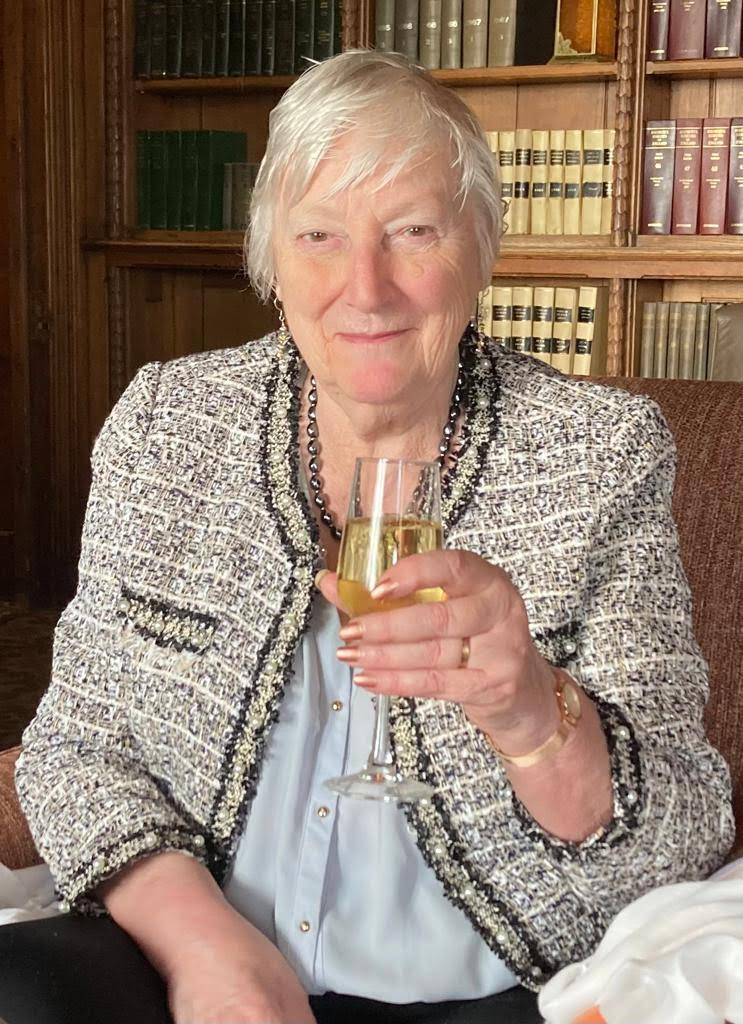
Sarah Das Gupta is a writer from Cambridge, UK who has lived and worked in Kolkata and Tanzania. Her work has been published in over twenty countries and she has been nominated for Best of the Net and a Dwarf Star.
A Life of Teaching, Memory, and Words: The Life of Sarah Das Gupta
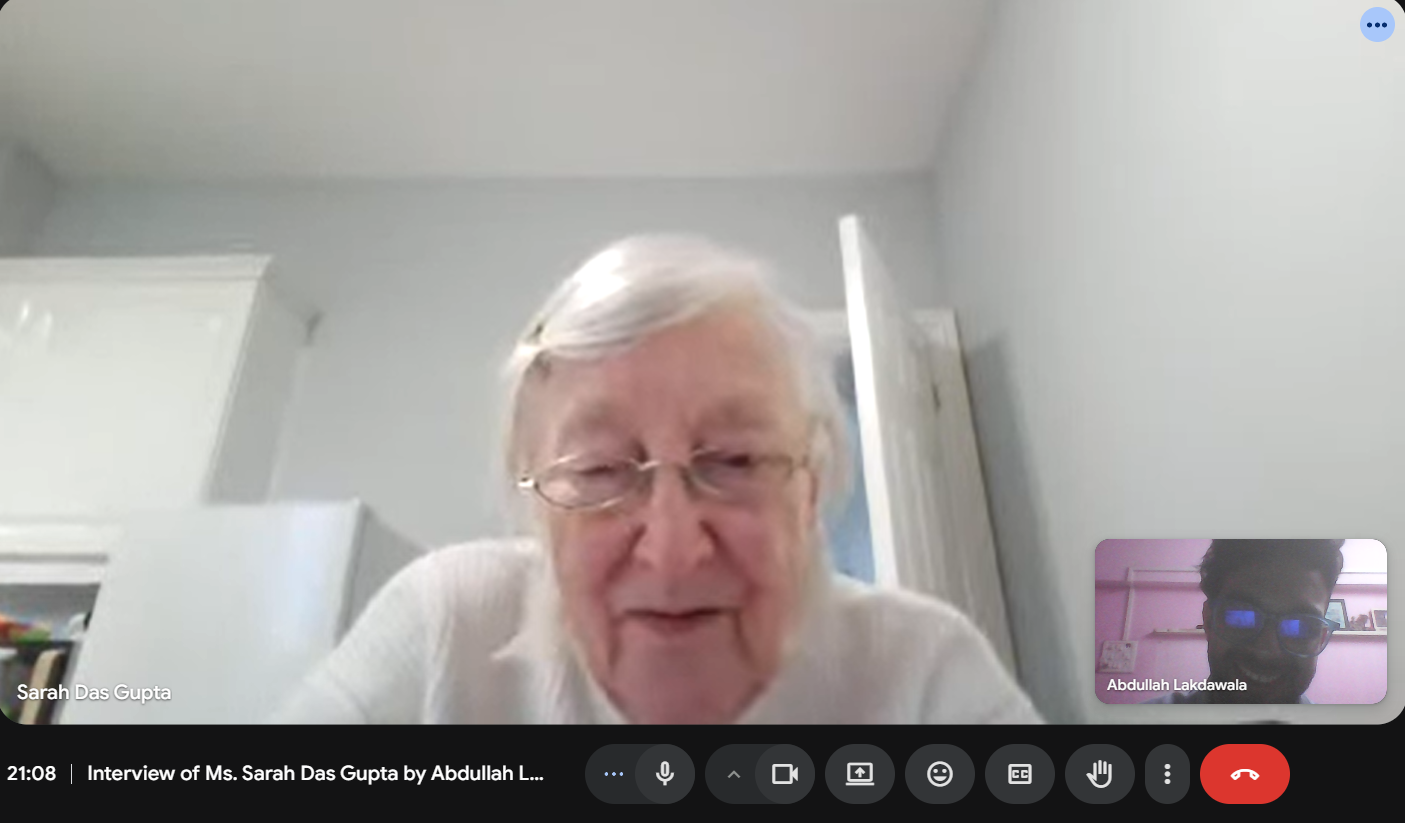
Abdullah Lakdawala in Conversation with Sarah Das Gupta
[Abdullah Lakdawala]: How long has it been since you were last here in India?
[Ms. Sarah Das Gupta]: Well, I lived in India for many years, but the last time I went back was about four or five years ago. I met many of my old students whom I used to teach, and they’re all on Facebook. They still keep in touch with me, send me birthday wishes, and all that. They’re lovely students.
[Abdullah Lakdawala]: Tell me more about your life, especially your teaching life. How was it?
[Ms. Sarah Das Gupta]: Well, I was a teacher for most of my life. I went to London University and studied history, mostly European history. That’s where I met my future husband, who was studying the same subject. I started teaching after I finished my degree and continued until I was about 80 years old. I only stopped because I had an accident. I slipped on the floor and fell badly against the corner of a room. I suffered a severe fracture of the hip. They operated once, then had to operate again, and ever since then my walking has been very limited. I can’t walk very much on my own now, which is one reason I don’t think I’ll go back to India again. Long journeys and airports have become difficult. So really, I taught from my early twenties until I was 80. I taught in almost every kind of school. In Calcutta, I taught at Loreto for many years. I’ve also been to Bombay. At Loreto, I introduced a great deal of drama because the students hadn’t really done much drama before. We performed Shakespeare. A Midsummer Night’s Dream was the first play we did. We did lots of productions and creative activities. At the time, I felt Indian education was very teacher-led, what we used to call “chalk and talk.” Teachers talked, students listened. It may be different now; I’m sure it has improved. But for the students I taught, my classes were something quite different from what they were used to. I really enjoyed those years. The other teachers were wonderful too. The school used to be run by Irish sisters; the nuns came from Ireland. When I went back years later, they were mostly Indian nuns from the South, I think. I had the feeling the atmosphere had become a bit more serious and strict compared to the way I taught.
Before one of my visits ended, I taught just one lesson. Afterwards, the students said, “Why don’t you come back? Your classes are such fun.” I told them, “You can have fun with other teachers too, but I’m a bit old now.” Still, I truly loved that period of my life. And I must say, Indian genes are very good academically. Both my children did extremely well; one went to Oxford, the other to Cambridge.
[Abdullah Lakdawala]: I also heard that you spent some time in Africa?
[Ms. Sarah Das Gupta]: Yes. After I returned to England, following my husband’s death, I worked at a school that took students every year to Tanzania in East Africa. I went there for about six weeks initially, but I stayed longer because I loved it: the people, the children, the teaching. The schools there were completely different from the schools in India. They were government schools: one secondary school and one primary school. We helped teach in both.
The children were wonderfully responsive, though in a different way from the Indian students. The Indian girls I taught were very well-read, serious-minded, and academically driven. Many of them later earned scholarships abroad and did extremely well in places like America. The African children mostly came from very poor farming families. Some families only had one pair of shoes between several children. So each child could only attend school once a week because they had to share the shoes. Many walked miles every day to get there. Considering all that, their English was remarkably good, and they were incredibly eager to learn. They constantly asked us to teach them songs because they were naturally musical, with a wonderful sense of rhythm. Unfortunately, I can’t sing at all. In fact, when I was young, my school once told me not to sing because my singing made the other children go out of tune. I came home crying and told my mother, “They won’t let me sing.” She simply said, “Never mind. You’ll find something else you’re good at.” Still, somehow, we taught the children songs. One day, during lunchtime, I noticed all the students were still sitting inside the classroom singing instead of playing outside. One older boy was leading them. I asked, “Why aren’t you outside playing?” And he said, “We’re practising the songs. We want to get them right.” I thought that was extraordinary. One of the primary schools was located on the edge of the Great Rift Valley. When you looked outside the classroom, you could see enormous flocks of bright pink flamingos by the water. It was one of the most beautiful places I’ve ever seen. I told the students, “You have the most wonderful classroom in the world.” And they replied, “Not really, Miss. We only have one toilet.” That stayed with me. The school facilities were very limited, but the natural beauty around them was extraordinary.
[Abdullah Lakdawala]: What are your favourite memories from India, Africa, and the UK? The moments closest to your heart?
[Ms. Sarah Das Gupta]: The births of my daughters, certainly. My second daughter was born during the Bangladesh Liberation War in the early 1970s. There was a blackout in Calcutta because of the war. No lights anywhere. I was teaching all day, heavily pregnant, and every time I stood up from my desk, I felt strange. I remember thinking, “Please don’t let me go into labour here.” The school was run by Loreto nuns, and I wasn’t entirely sure they’d know what to do if I suddenly had the baby there.
I managed to finish the school day and took a taxi home, which, in Calcutta traffic, was an adventure in itself. My elder daughter was only a year old at the time. We had a maid named Natalie, who was fascinating. She was Catholic but also deeply devoted to Ganesh. She seemed determined to stay on good terms with every religion, just in case one of them turned out to be correct. She refused to eat beef and kept a picture of Ganesh facing the doorway at all times. When I got home, she looked at me and immediately said, “You go to the hospital now.” I said, “Yes, but how? There’s a blackout and no transport.” At that moment, a taxi appeared. The driver looked half-asleep, and the vehicle was backfiring all the way down the road. I remember clutching my stomach and trying to explain that I needed to get to the hospital immediately. Eventually we arrived, and one of the nurses rushed me inside. The sister in charge shouted, “Get her upstairs quickly or she’ll have the baby on the floor!” The birth happened very quickly. Afterwards, when the doctor finally arrived, I remember telling him, “You don’t expect me to pay you, do you? You weren’t even here!” He laughed and said he’d been stuck in traffic because of the blackout. It was frightening at the time, but memorable too. Another memory that has stayed with me is the cremation I mentioned earlier, especially the ending, with people drying their clothes by the fire. And now, of course, my grandchildren are among my happiest memories. Grandchildren are wonderful because you can love and spoil them without carrying the full responsibility of parenting.
One of the greatest rewards of teaching is not working with naturally brilliant children. They would succeed anyway. The real joy comes from helping students who struggle, who might otherwise fail.
One of the greatest rewards of teaching is not working with naturally brilliant children. They would succeed anyway. The real joy comes from helping students who struggle, who might otherwise fail. I remember one girl I taught in England during my final years of teaching. She was half Nigerian and half Sierra Leonean. Her father had died, and her mother suffered from severe mental illness. The girl had spent years in foster care and had experienced terrible abuse. Most teachers had given up on her. She rarely attended school, struggled emotionally, and seemed completely disconnected. But I knew she was intelligent, especially in English. She had a remarkably sophisticated understanding of literature. The only other teacher who believed in her was the art teacher. Together, we pushed her gently but persistently. Eventually, she passed English, Art, and Photography, and later went on to study Law and Politics at university in London. A few years later, she emailed me saying she had successfully completed her first two years. That made me incredibly happy. Those are the moments that matter as a teacher, when you know someone might not have succeeded if you hadn’t kept believing in them. Teaching runs in my family. My father was a teacher too, and he was excellent at explaining difficult ideas in simple ways. Often, the cleverest people are not the best teachers because they can’t understand why someone else struggles. Good teachers are patient. They understand the difficulty.
I’ve written a little about those experiences. Teaching in those schools, and also in rough schools back in England, taught me a great deal. You don’t become rich being a teacher. But seeing children from difficult backgrounds succeed gives you immense happiness. Even now, many of my students from India still stay in touch with me online. I’ve reached the age where more of the invitations I receive are for funerals rather than weddings. When you get older, you realise your social life changes; suddenly it’s mostly funerals. One of the most unforgettable experiences I had in India was attending the cremation of my husband’s father. He died while the family was at the hospital. The hospital insisted we take the body immediately because it was summer and they couldn’t keep it there long. So my husband and I went to the burning ghats alone. The men preparing the funeral pyre seemed unhappy, and I asked my husband why. He told me it was because I was there, a woman at the cremation ground. Eventually we simply paid them a little extra money and they accepted it. It takes almost an entire night for the body to burn completely. By morning, poor people from the riverbank came carrying wet clothes. They held the clothes near the fire to dry them. I thought my husband might find that disrespectful, but instead he said, “No. It’s the one good thing that has happened tonight. The fire is helping people.” That stayed with me. India gave me many unusual and unforgettable experiences.
[Abdullah Lakdawala]: Moving on. Now that you’ve become a writer later in life, how does writing feel to you? What kind of joy does it bring?
[Ms. Sarah Das Gupta]: Becoming a writer happened almost accidentally. After my accident, I spent a long time in hospital in a geriatric ward. Some of the patients had dementia. One woman threw a cup of tea at me shortly after I arrived. Thankfully, it wasn’t hot. A few minutes later, the same woman politely offered me a cup of tea as though nothing had happened. At night, there was constant shouting and confusion. I told my daughter, “If I stay here much longer, I’ll go mad. I need something to do.” As she was leaving, she threw a magazine onto my bed. It was a writing magazine listing competitions for short stories and poetry. She said, “Why don’t you try? It’s never too late.” So I began writing. I stole some NHS paper from the ward and started working on a historical story set in the early nineteenth century during the age of stagecoaches. I suddenly realised how many tiny details a writer has to research, things like what kind of glass people used in windows or how torches were made.
I wrote mostly at night because I couldn’t sleep anyway. The woman with dementia, the same one who had thrown tea at me, developed a strange ritual. Whenever I finished a page, she would come over, pick it up, look at it carefully, say, “Good, good,” place it neatly on the pile, and then go back to bed peacefully. Oddly enough, everyone in the ward became happier once I started writing. By the time I left the hospital, I had written several stories and some poems. My daughter encouraged me to send them out, and that’s how my writing life began. Now writing has become my routine. I usually wake up around ten because I work late into the night. I need daily injections from a nurse because of my condition, and after that I sit at the computer and write until evening. Sometimes I enter competitions. Sometimes I just write for myself. At night, I watch the BBC News and occasionally a good film or documentary. I’m not someone who watches television constantly, only things I genuinely want to see. And yes, I know the BBC receives endless criticism, but honestly, if Donald Trump is suing them, I consider that almost a badge of honour. America remains one of the great mysteries to me, a country capable of producing extraordinary scientists and achievements, yet still capable of electing someone like Trump. I don’t think I’ll ever fully understand that contradiction.
[Abdullah Lakdawala]: What are you working on these days? What can readers expect from you in the coming years?
[Ms. Sarah Das Gupta]: Well, you know, obviously the problem when you start something late is that you don’t have so much time. I mean, I’m not oblivious of the fact that I’m 84, so I know there’s only so long. What I would really love is to have an anthology of poetry published. Not self-published, because I don’t really believe in self-publishing. I think anyone can do that if they’re willing to pay for it, regardless of whether the writing is good or not. I would love to have a proper collection published. Usually, an anthology is around sixty or seventy pages, though you can also have what’s called a chapbook, which is shorter, perhaps twenty pages or so. I may begin with a chapbook first. The only problem is that I don’t write about just one thing. Some writers have a very specific theme: romance, love poetry, or one particular genre. I don’t really work that way. I’ve written a lot of horror, actually, because I think horror is a very interesting genre and can be used in intelligent ways. I also write a great deal of poetry inspired by the natural world because I grew up surrounded by nature.
My father was a teacher, but we also had a farm on the highest point of the North Downs in southern England. I grew up around animals. We had about fifteen dogs, cats, horses, and all sorts of things. I’m very used to being outdoors. My father knew a great deal about wildflowers and plants, and he would teach us their names and show us different species. So I write a lot about nature and the changing seasons, which in England are very distinct. I’ve travelled quite a bit in India too. I’ve been to Darjeeling and to Orissa several times. Historical buildings fascinate me. I even wrote a poem about Konark, where the famous Sun Temple is located. It’s a UNESCO World Heritage Site and an extraordinary place. I write about people as well. I write about hospitals, illness, and dying. So I don’t really have one single theme, but I do think I have a distinct voice. I don’t particularly admire poetry that is simply prose broken into lines. I’m not saying poetry must rhyme, because mine usually doesn’t, but I do think language should have rhythm and musicality. Quite a lot of modern American poetry, to me, just feels like paragraphs arranged differently on a page. And I don’t really understand the obsession with profanity either, using the f-word every other sentence. I don’t see why that’s necessary. To me, it often feels like a limitation of vocabulary rather than expression. I love the sound of Bengali, especially in translation and when spoken aloud. Even though I never learned it properly, Bengali has a very strong rhythm and wonderful alliteration. I think it may be difficult for me to publish a collection because publishers often want one clear theme or genre. If I do put together a collection, I think it would probably focus on North Wales, my years in India, and my experiences in hospitals while learning to walk again. That would at least provide some unity.
Lately, I’ve also begun writing a great deal about the Second World War because I was born during it, in 1942. My father served in the Navy, but he never spoke about the war. If we asked him questions, he simply wouldn’t answer. I later realised it must have been deeply traumatic for him. He was in charge of one of the guns at the back of a warship, and many of the young men serving under him were probably around your age. If the ship was attacked, those gun positions were often targeted first, so many of those boys were killed. We simply never discussed it in our family. Perhaps because of that silence, the war has always fascinated me. My own godfather died during it. I still have vague memories of seeing planes flying over London during the Blitz. German planes would sometimes fly over our land on their way back across the Channel. If they had bombs left over, they would drop them before returning to Germany to lighten the aircraft. We had several bomb craters in our fields because of that. I think I feel drawn to writing about that period because my memory of it is strangely vivid. I have an unusually strong visual memory. I can remember tiny details from childhood with astonishing clarity. The other day, while trying to write something, I suddenly remembered the exact look of muddy tracks around our farm, the imprints overlapping in the soil. It was as though I were watching a film in my mind.
I especially remember the countryside, the horses, the fields, all of it. So I may eventually write a book connected to the Second World War, though it would be a very narrow perspective, focused on that particular part of England. We lived very close to Biggin Hill in Kent, which was one of the major RAF airfields during the Battle of Britain. Pilots flew from there constantly. My grandparents had a large house nearby, and because they had extra space, the government required them to house airmen during the war. I remember my grandmother saying that almost none of the young pilots survived. She would get to know them for a week or two, and then they would be gone, killed in combat, and another group would arrive. Even as a small child, I vaguely remember standing near the woods by their house and watching German planes crossing the sky on their return journey. I think it’s important to write about those things because people are beginning to forget them. I’m shocked by how little my grandchildren know about the Second World War, especially considering how deeply involved their grandfather and great-grandfather were in it. I feel a certain obligation to preserve those memories somehow. Even after the war, its presence lingered in everyday life. We still had gas masks. We played games based on wartime stories. The bomb craters remained in the fields, and old air-raid shelters became playgrounds for children. The first school I attended was partly made up of old army huts left over from the war because so much rebuilding still had to be done in England. And the first film I ever saw was Laurence Olivier’s Henry V, which was dedicated to the pilots and soldiers of the war. That was my first introduction to Shakespeare. I didn’t understand much of it at the time, but I sensed its importance. So yes, I do feel an obligation to write these things down before they disappear.
The funny thing is that none of my own children read anything I write. Other people do, but not them. I suppose it’s difficult to judge the work of someone you know too closely. At the moment, I’m also rereading Russian novels, in English, of course, because I don’t know Russian. I managed to read War and Peace and Anna Karenina, which feels like quite an achievement. Anna Karenina is extraordinary. It’s about eight hundred pages long, but it gives you such insight into Russia and human nature. Now I’ve moved on to Dostoevsky. I’ve just bought Crime and Punishment, which was my husband’s favourite novel. My husband was also a great admirer of Subhas Chandra Bose. He considered him one of Bengal’s great heroes. I’d like to read a bit more about it as well. There is always something to read; that’s one thing you can be sure of, you’ll die disappointed that you haven’t finished reading everything.
About the Interviewer

Flipping through the chapters of life on a midsummer night, like a day dreamer’s charm, Abdullah Lakdawala is a socialite, a writing freak and a soul on fleek.



 The Hemlock Journal
Leave a comment