Poetry always holds much more than what we see on the surface. It’s like a vast sea, and usually, we are only ever able to decipher a fraction of its depths. When I read “Almanac of the Sickle Moon” by Jyotish Chalil Gopinathan, that was the first thought that came to my mind. The preface really sets the tone, letting the readers get a quick idea of the whole book.
In the author’s own words, “One emotion that seems to unite us all is our response to loss: grief.” But as the preface explains, this isn’t just about one kind of loss. It can be about losing family, friends, a nation, an idea, or even parts of yourself. The book is really an exploration of how we respond to those voids left behind.
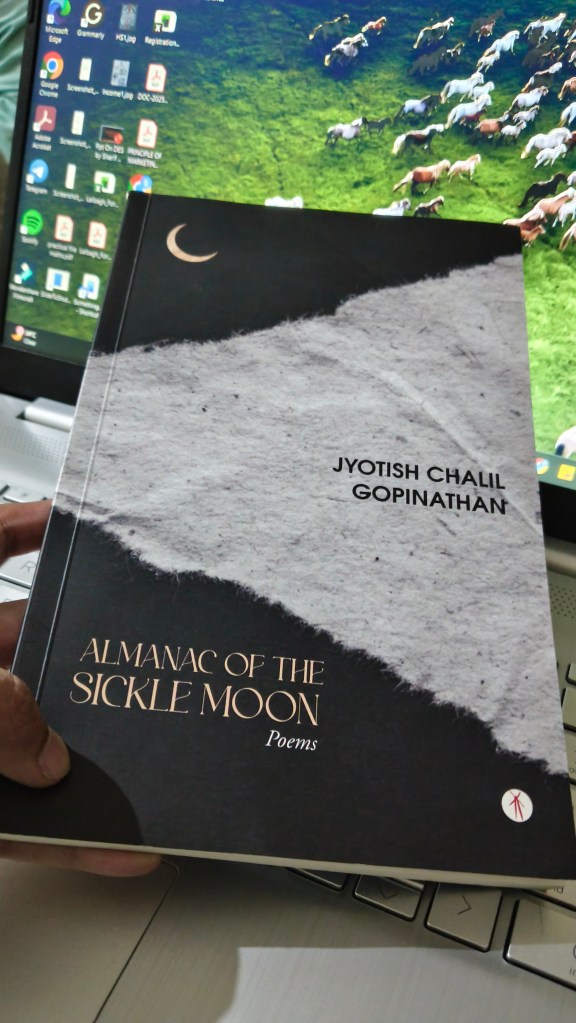
The title is very clever. An “Almanac” is usually a book of astronomical and meteorological data, but here, this book is a 25-year record of human experience, moving from quiet, personal thoughts to a global perspective. Then you have the “Sickle Moon,” which is a perfect symbol for the book. It represents that thin line between creation and destruction, or the “interrupted” nature of life. Depending on the poems in the collection, the moon acts as a cradle, a tool for survival, unsaid thoughts or feelings, or even a warning of something impending.
The book is divided into 6 sections – Sui (self), Familia (family), Amicis (friends), Alii (others), Gens (nation), and miscellanea. Each part has its own vibe, but they all unite to show the core theme: how we live with grief and absence.
1) Sui (Self)
In the opening part, the writer reflects on his thoughts about identity as well as the burden of daily life and how tough it is to be creative in such circumstances. You get a clear view of this difficulty in poems such as ‘Writer’s Block’ and ‘A Day in the Life of a Minor Poet’ as they beautifully bring out this tension between the inner and outer worlds. There’s a really raw moment in ‘Brown Butterfly’ too, which touches on the sting of childhood colourism in a way that feels very personal. Then you have poems like ‘Sinking’ and ‘Evaporation,’ which just honestly describe that feeling of being totally overwhelmed, like you’re slowly losing your grip on who you are. This section does a beautiful job of showing the weight of all the things we leave unsaid and how fragile we really are when we’re forced to be vulnerable.
2) Familia (Family)
In this section, the poet shifts to a wider part of the individual from self to ancestry, legacy and domestic sphere. Poems, ‘Jewel Box’ and ‘Genealogy’ talk about the weight of inheritance and memory. ‘Halfway to Heaven’ and ‘Pretend Lives’ are about parental grief and protection. The poem, ‘Names’, reflects the difficulty in naming or labelling things/people that are a part of the family. Here, Familia is about system – the web of DNA, shared grief, and domestic rituals that trap and sustain us. The poems portray that family is something that provides comfort and stability, but also prevents individuals from drifting into the freedom of the unknown.
3) Amicis (Friends)
This section deals with the connections we make with people/things/places that are not a part of our lineage (family) but are an important part in our lives. Amicis is more like a study of the relational residue, exploring the “finality” of certain moments—a final kiss, a final button undone and how those moments are preserved through a process of emotional “redaction.” ‘Places I would Go Back to’ and ‘Trapment’ explore the geography of memory or map emotions onto physical locations. ‘Redacted’ is a standout piece that uses a blacked-out document as a metaphor. ‘Waterfall’ captures raw moments of observation. ‘Asthi Visarjan’ is about mortality and ritual. The poems simply portray that love and friendship are not static states but kinetic forces that leave us with a rock garden of memories.
4) Alii (Others)
After talking about self, family, and friends, the poet, in this section, explores his relationship with other things. These could be stranger, collective things and brutal realities of the world. Poems like ‘In the Company of the Poet’ and ‘Bonsai’ question the magic of the creative processes. ‘The Things that Arrive’ and ‘The Way Light Shines’ display the ‘others’ as an effect of global events on a human. The poem, ‘Driven by Human Hands’ lingers with the introduction of buses as vessels of memory, beginning with happy moments of childhood to ending with devastating reference to the 2012 Nirbhaya case. In short, Alii is about witnessing. ‘Others’ are not just strangers but the mirror through which we see our own capacity for both creation and destruction.
5) Gens (Nation)
This section feels a bit heavy and political. Earlier sections feel more personal, dealing with self, family, friends, others, but this section looks outward to the mess in the world we live in. It confronts collective trauma, societal violence, and the erosion of justice. This way, it is definitely a shift from the quiet, inner thoughts we see at the start; instead, it feels more like a mute scream against everything happening in society today. ‘October 2nd 2003’ is a mournful reflection on the legacy of Mahatma Gandhi. It suggests that the ideals of the past and the present reality are very different from each other. ‘Easter Morning’ and ‘Quicksand’ describe how violence is not only tolerated but also celebrated in modern society. ‘Easter Morning’ specifically points out how a murderer is released from jail and is welcomed with garlands and frothing slogans. By use of words like “Hosanna” and “new messiah”, the poet bitterly critiques how a criminal is celebrated as if he were a messiah.
Gens is a powerful section that unapologetically indicts society for losing its way. In this section, the personal grief moves towards the grief of societal collapse.
6) Miscellanea
In the last section, Miscellanea, the poet shifts the whole focus from political confrontation to the relationship between people and nature. This section talks about how the environment is decaying and how small we really are compared to the world around us. It describes how human waste has become inseparable from nature. Nature in this section is rarely peaceful; it is often a force of sudden, crushing impact. It also includes the interaction of humans with wildlife. The last poem of this section and the whole collection, ‘Ferns, Olavanna,’ is about a fern planted by the author. He ends it with these lines:
I know I write
like I design
and tend to
this garden.
Some poems in this collection have been published on different platforms, which are mentioned in the footnote. Poems, ‘Insomnia’, ‘October 2nd 2003’, ‘The Day They Lynched Me’, ‘What the Photograph Tells the Poet’, etc., have appeared in The Punch Magazine 2025. Some others have appeared in Poems India, Ethos Literary Journal, and The Chakkar.
The poems depict highly elemental and visceral imagery, shifting from the internal world of the mind to the external world of flesh and bone. Throughout the book, the poet uses tactile and sharp imagery. It is also decaying and sinking, sometimes domestic and destructive. The poet uses words like ‘watery’, ‘sinking ships’, and ‘quicksand’ as if he is getting drowned in his own trauma while trying to stay buoyant in this world. The poet takes small, household objects and turns them into something haunting.
The book doesn’t end with an answer or a resolution. Instead, it ends like the sickle moon itself—with a “question mark” and the “interruption of light,” leaving the reader to navigate the sinkhole of history on their own.
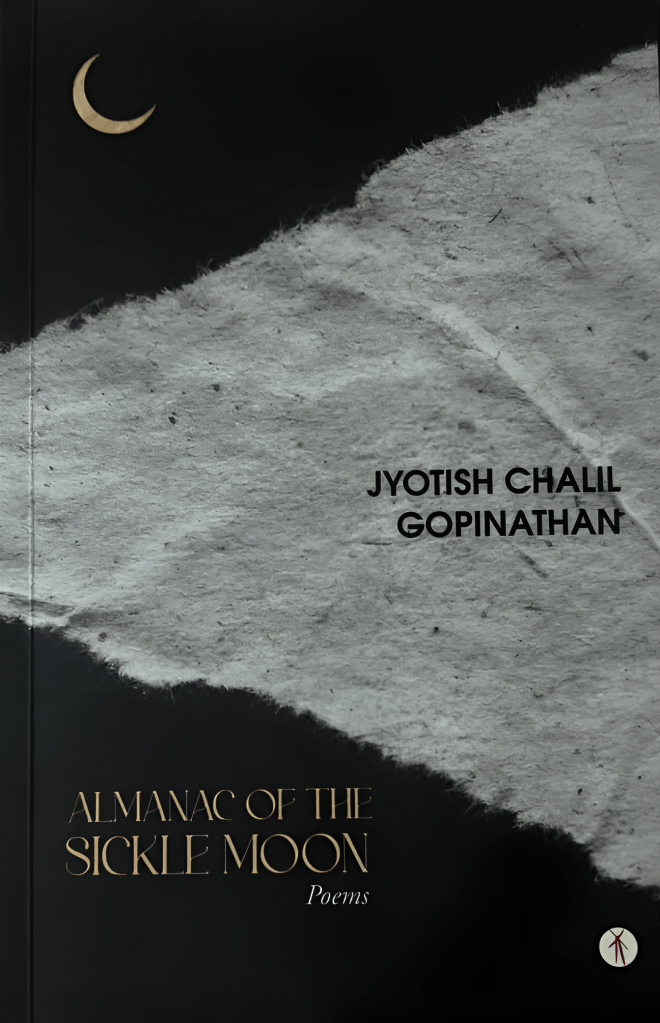
Title: Almanac of the Sickle Moon
Author: Jyotish Chalil Gopinathan
Publisher: Hawakal Publishers
Publication Date: 30 August 2025
Language: English
Page Count: 142 Pages
About the Author

Jyotish Chalil Gopinathan is a nephrologist, postgraduate teacher and researcher residing in Kozhikode, Kerala. His first book of poems, The Coppiced House, was published in 2024. Dr. Gopinathan’s poems have appeared in various journals, including Muse India, Madras Courier, Poems India, Ethos Literary Journal, The Punch Magazine, and Borderless Journal.
About the Reviewer

Shazia Parveen is a writer, poet, and thinker who writes under the pen name ‘Sana’. Born and brought up in Lucknow, she completed her post-graduation in Chemistry from the University of Lucknow. She works as a Content Writer in a private firm and has been in this field for five years. She has co-authored two Hindi anthologies and published her debut book ‘Homecafe’ in 2019. She also edits The Hemlock’s digital and print issues and anthologies. Once a teacher, Shazia believes that “Writing is a journey of learning each day.”




 The Hemlock Journal
Leave a comment