Sourish will speak no more.
But the pen will.
His shadow will.
His memory will continue to speak.
Sourish is everywhere now.
Yet he will never again sit beside me and read a story. I will never hear his new writing. He will never lean toward me and say, “Write, write—what are you doing?”
An extraordinary writer and a dear friend, Sourish Dutta, left us today. Fifty-two or fifty-three is no age to die. Yet he is gone.
And his departure has made one thing painfully clear to me: a strange, silent massacre is underway. A silent genocide. A slow extinguishing of those who dare to dream, who dare to rebel with words. And everyone watches. The left, the right, the apolitical, the feminists, the anarchists—everyone. All sit quietly in the amphitheatre, enjoying this sticky spectacle of violence.
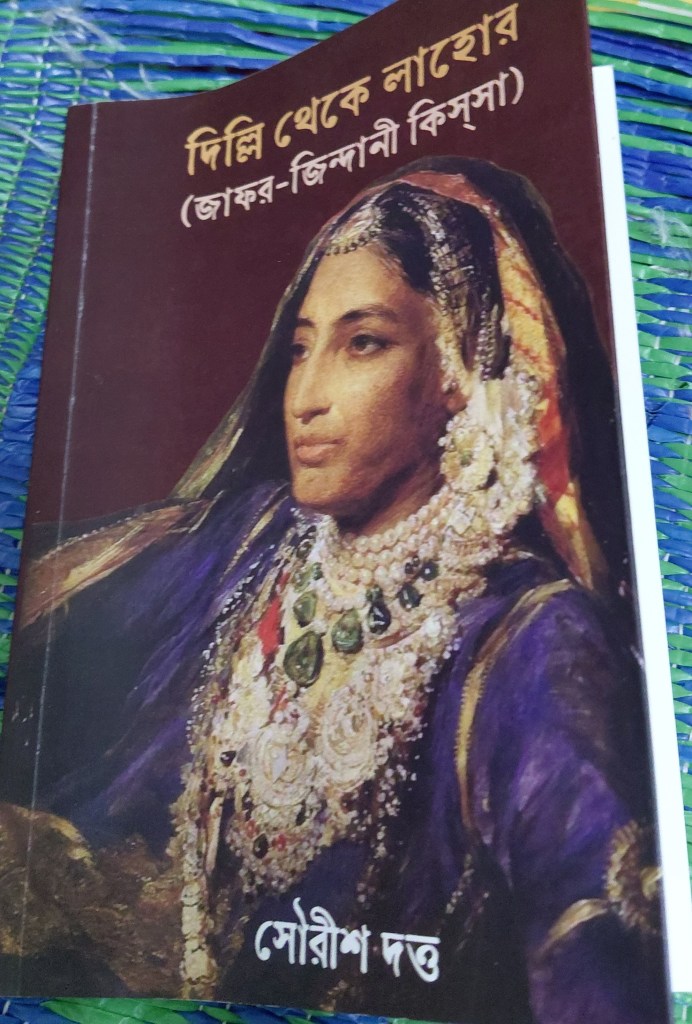
Sourish was perhaps seven or eight years older than me. Yet he was incredibly close. In his book Delhi to Lahore (The Tale of Zafar Zindani) there is a line that stops the reader cold. An English officer says:
“Shorten the noose. If the rope is too long, the spectacle isn’t quite as good. Watching a man twitch in the air like a decapitated chicken, struggling to die slowly—that is a splendid entertainment.”
Writers like Sourish Dutta struck at power in precisely this way. Their pens shook the neat calculations of the system—the theories, the structures, the cruel entertainments of death warrants.
Sourish belonged to that rare tribe of writers who cared for nothing except the truth of the page. Today, when writers advertise themselves endlessly—announcing which celebrity launched their book, which festival invited them, or proudly declaring, “This Durga Puja I will be cutting ribbons everywhere”—Sourish was a fierce rebellion against that culture.
Many times I, writer Upal Mukhopadhyay, and Sourish travelled together through strange landscapes of storytelling. Where Upal-da’s story ended, Sourish would begin. Sometimes I would continue the thread.
His book Delhi to Lahore was written in that spirit. While Upal-da was working on Aurangzeb, Sourish was writing another tale of rebellion from the same historical moment—creating a luminous literary duet.
His short stories broke the very architecture of narrative. He entered the hidden manholes of storytelling and returned with new possibilities of prose. In that vast terrain of language I sometimes saw Sourish and his fierce pen flying alone like a butterfly, sometimes marching like a foot soldier, sometimes drifting like a solitary cloud across a burning sky.
And perhaps that is why thinkers like him are attacked so brutally in our society.
He painted beautifully too. His prose carried the same painterly magic. At times I feel that the prose of our Bengali writer Sourish stood close to that of Orhan Pamuk or Gabriel García Márquez—perhaps, in flashes, even surpassing them.
But this is the strange kingdom of Shiva. Here stones become megahit idols while true artists quietly disappear.
Yet even within this story of disappearance, the strange colours of spring continue to flow through Sourish’s life and writing—spreading across the page like the first light of morning.
Open Delhi to Lahore and a single sentence may strike you with sudden force. Or perhaps the book will quietly lead you to stand before a mysterious waterfall of words.
His writing walked the path between storytelling and the breaking of stories with a line from Amir Khusrau:
“If there is paradise anywhere in this world, it lies somewhere along the bend of this road.”
And so, along the many stony bends of this valley of death, perhaps the road itself whispers something to us: even if everyone else falls silent, the writer’s pen will still summon the storm.
I will miss this beloved writer and friend for the rest of my life.
And I will demand an accounting of this death.
Note- The Bengali cover of Sourish Dutta’s novel Delhi to Lahore, a book that continues to speak even after the writer’s silence.



 The Hemlock Journal
Leave a comment